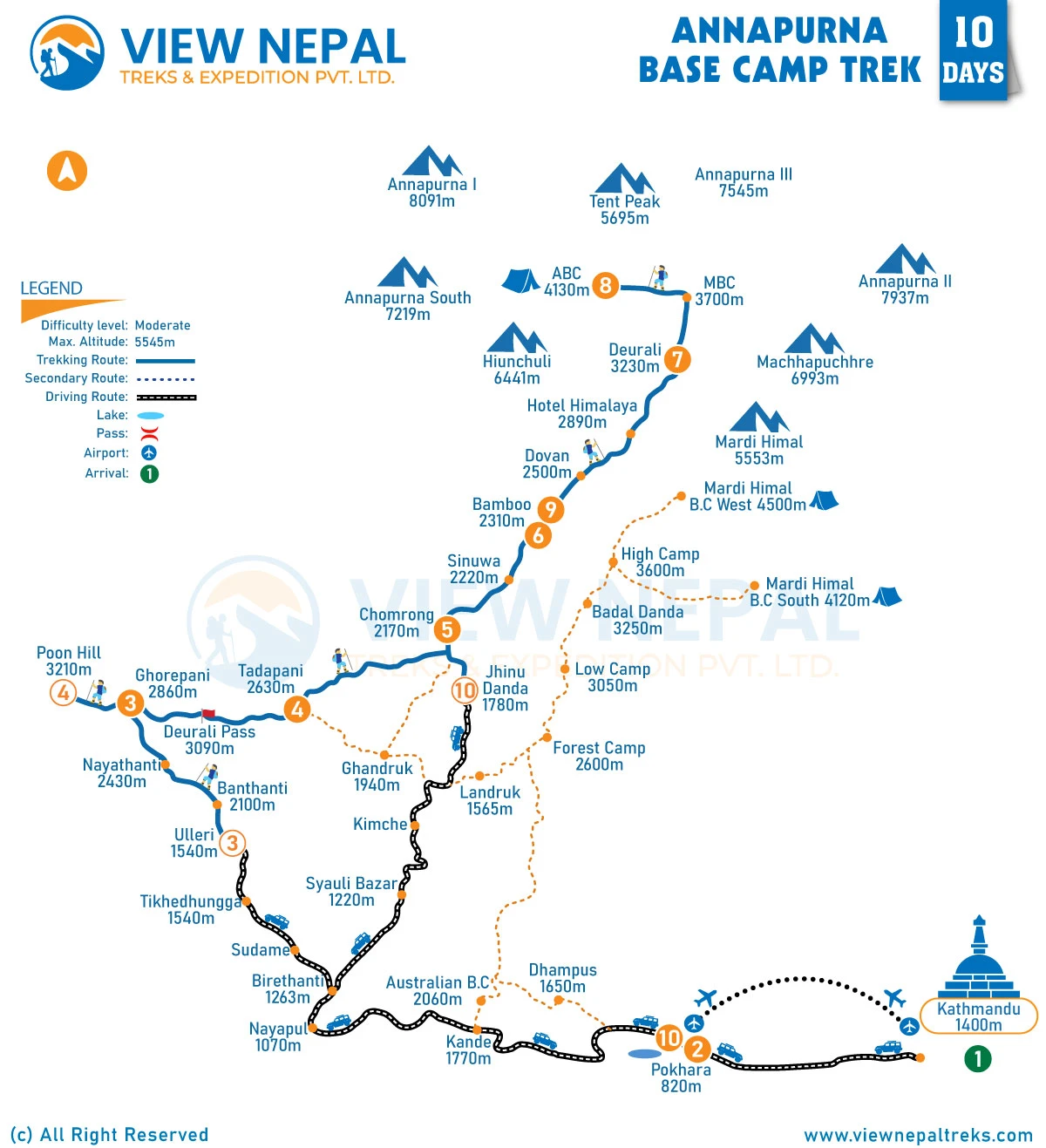
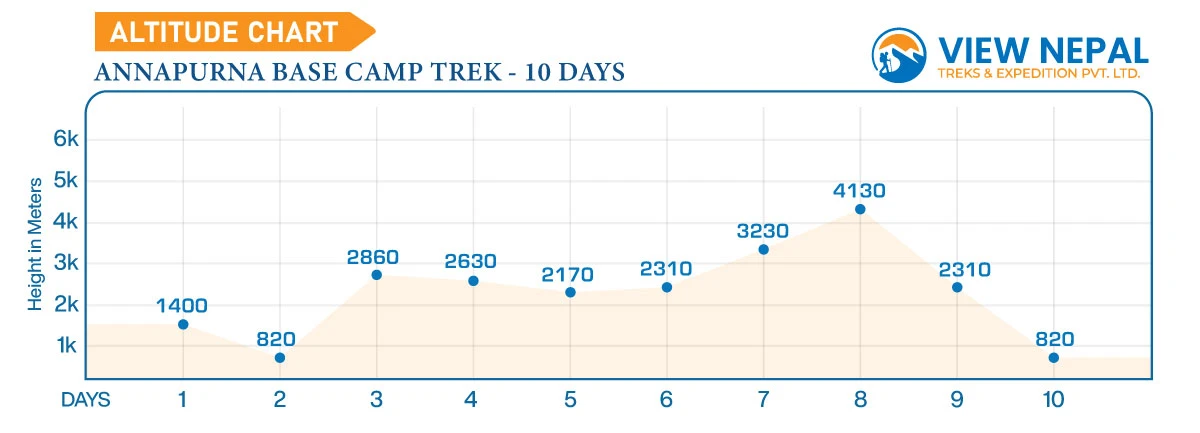
Day-by-Day Altitude and Distance Table
|
Day
|
Route
|
Starting Altitude
|
Ending Altitude
|
Altitude Change
|
Approx. Distance
|
Walking Time
|
|
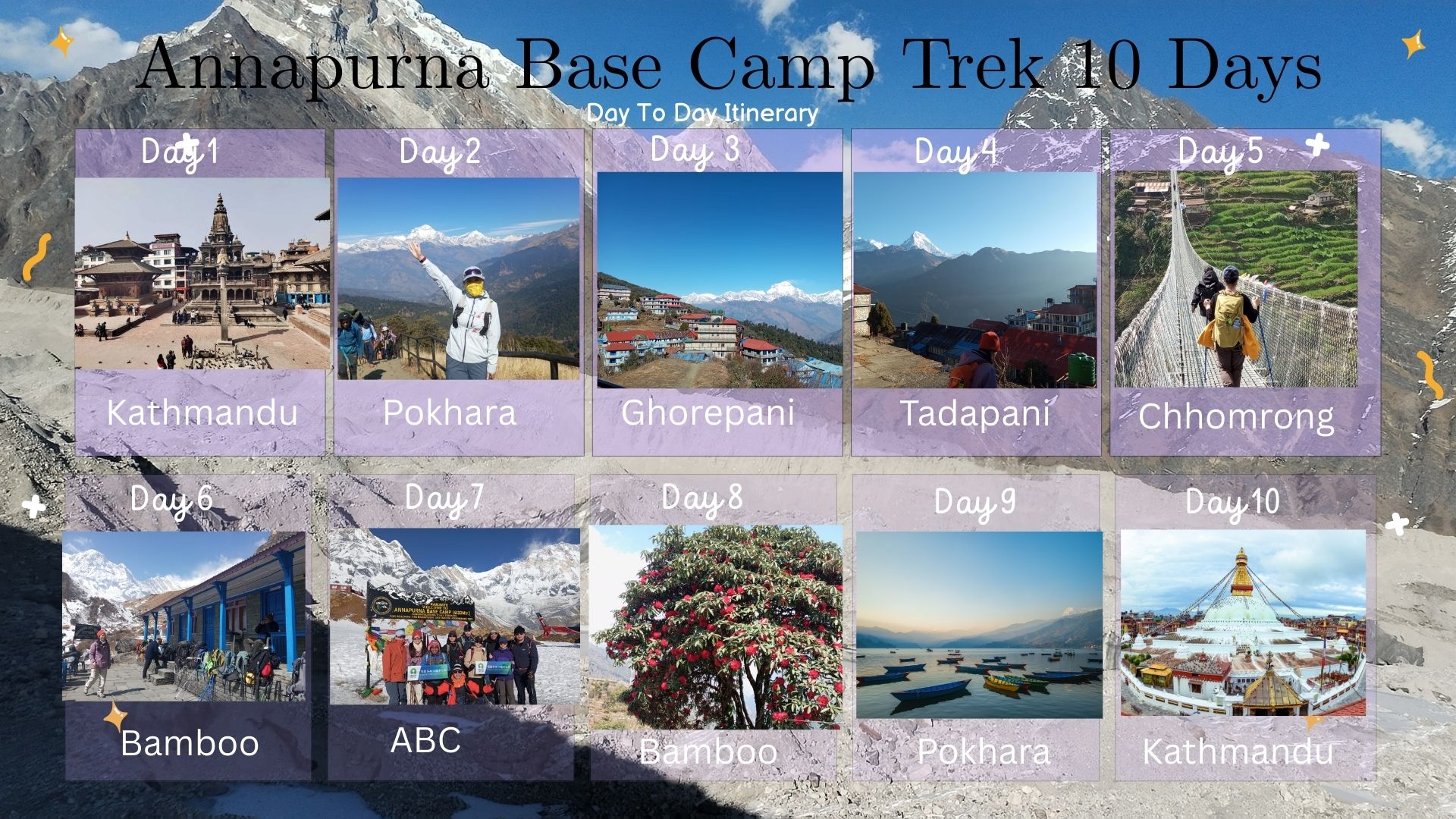
1
|
Arrive Kathmandu
|
—
|
1,400m
|
—
|
—
|
—
|
|
2
|
Kathmandu to Pokhara
|
1,400m
|
820m
|
—
|
Drive/Flight
|
—
|
|
3
|
Nayapul to Ghorepani
|
1,070m
|
2,860m
|
+1,790m
|
13 km
|
6–7 hrs
|
|
4
|
Poon Hill & Tadapani
|
2,860m
|
2,630m
|
+350m / −580m
|
12 km
|
6–7 hrs
|
|
5
|
Tadapani to Chhomrong
|
2,630m
|
2,170m
|
−460m (net)
|
10 km
|
5–6 hrs
|
|
6
|
Chhomrong to Bamboo
|
2,170m
|
2,310m
|
+140m (net)
|
8 km
|
4–5 hrs
|
|
7
|
Bamboo to Deurali
|
2,310m
|
3,230m
|
+920m
|
8 km
|
5–6 hrs
|
|
8
|
Deurali to ABC via MBC
|
3,230m
|
4,130m
|
+900m
|
9 km
|
5–6 hrs
|
|
9
|
ABC to Bamboo
|
4,130m
|
2,310m
|
−1,820m
|
17 km
|
6–7 hrs
|
|
10
|
Bamboo to Jhinu, drive Pokhara
|
2,310m
|
820m
|
−530m trek
|
7 km + drive
|
3–4 hrs trek
|
Best time to Trek Annapurna Base Camp
The best time to trek to the Annapurna Base Camp is during Spring (March, April, and May) and Autumn (September, October, and November), when the weather is favourable and moderate, with clear skies and cool temperatures, which are perfect for trekking.
Spring (March, April, and May)
In Spring, the weather is moderate and pleasant in the Annapurna Region. You'll experience warm days and comfortable temperatures, which are perfect for walking. The rhododendron forests are in full bloom, making the scenery incredibly beautiful and colorful, like you are walking in a natural garden. The skies are usually clear, offering you alluring views of the mountains. The perfect month for trekking in Annapurna Base Camp is April.
Autumn (September, October, and November)
Autumn is another perfect season for trekking to the Annapurna Base Camp. After the monsoon season, the air is super clear and crisp. You'll get stunning, unobstructed views of the mighty Annapurna Massif and other peaks. The weather is stable, dry, and the temperatures are cool but not freezing, creating ideal conditions for your trek. The appropriate month for trekking in Annapurna Base Camp is October.
Accommodation and Food on the Trail at Annapurna Base Camp
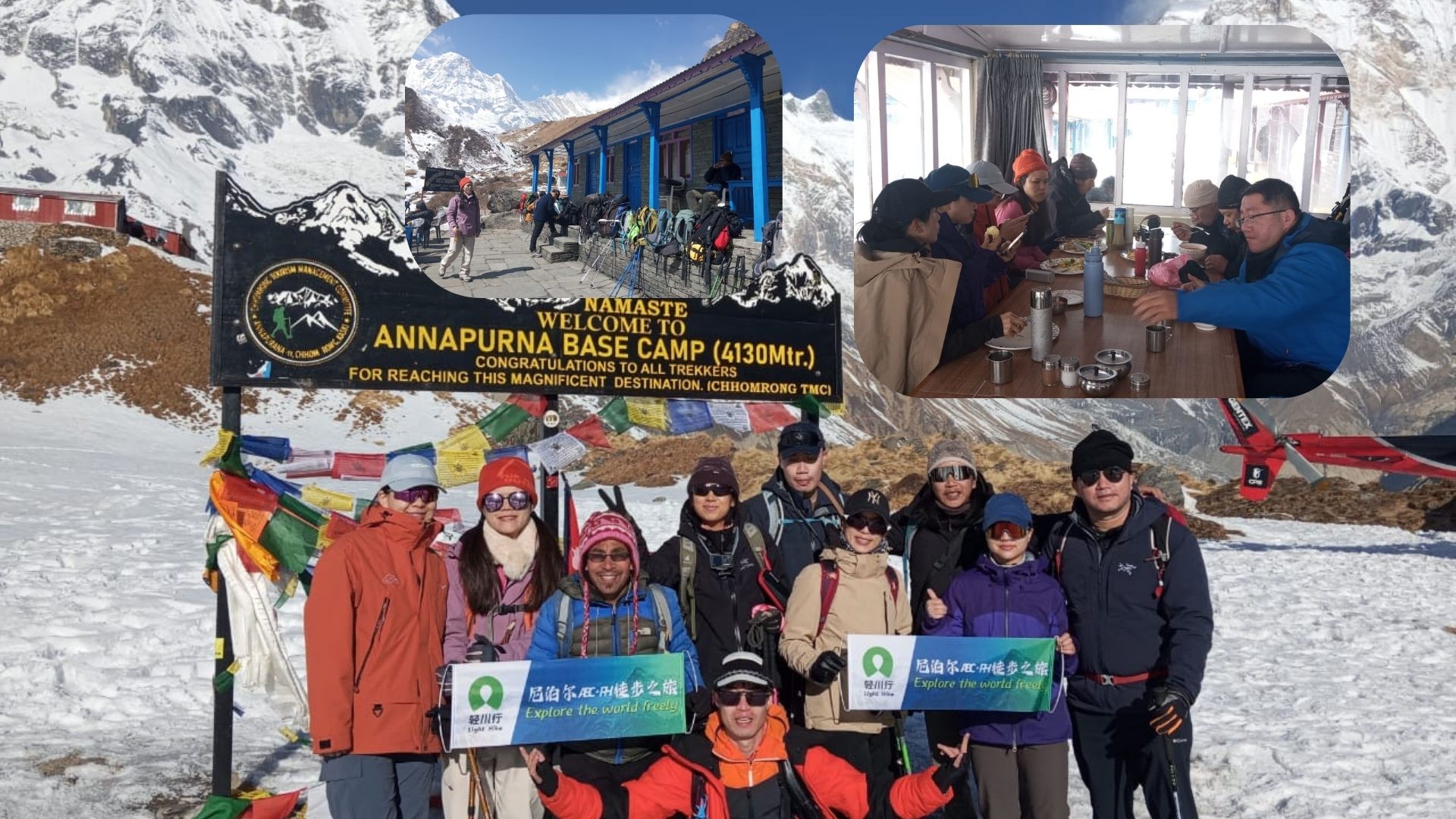
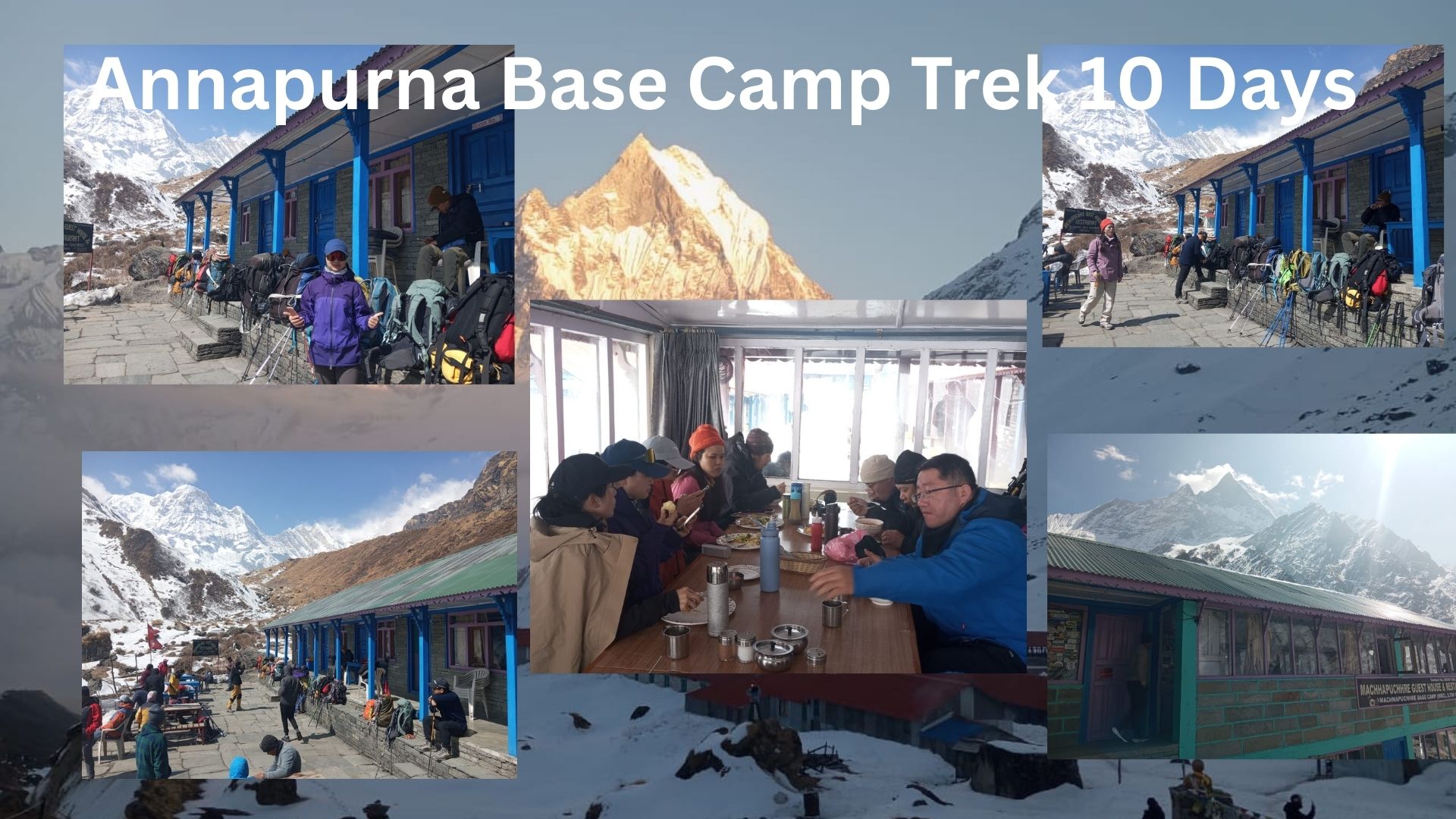
Below 3,000 meters, rooms are typically wood-paneled with foam mattresses, blankets, and occasionally attached bathrooms. Above 3,000 meters, rooms become more basic—thinner walls, shared squat toilets, and no heating apart from the dining hall stove. We select the best available teahouse at each stop, prioritizing cleanliness, reliable kitchen standards, and the warmth of the host family.
Room Standards
The accommodation in the Annapurna Base Camp Trek is basic, with two single beds, a small table, and blankets. Some rooms have attached bathrooms, but many share bathrooms outside. Hot showers are available in some places, but you usually have to pay extra. Nights can get very cold, so it’s a good idea to bring your sleeping bag for extra warmth.
Food and Dining
Teahouse menus follow a standard format across the Annapurna region: dal bhat (lentil soup with rice, vegetables, and pickles), fried rice or noodles, momos (Nepali dumplings), pancakes, porridge, and soups. Dal bhat is the best value and the most nutritious option—it comes with unlimited refills and provides the carbohydrate load your body demands at altitude. Western-style dishes like pasta and pizza are available at lower elevations but become less reliable above Deurali.
For trekkers with specific dietary needs—vegetarian, vegan, gluten-free, or halal—the teahouse system is surprisingly accommodating. Dal bhat is inherently vegetarian. Egg-based dishes are widely available. Our guides communicate dietary requirements in advance and verify ingredients at each kitchen.
Luxury Lodge Alternative
For those seeking higher-end accommodation, an Annapurna Base Camp luxury lodge trek can be arranged on the lower sections. Properties operated by Ker & Downey and the Annapurna Lodge Trek network offer private en-suite rooms, hot showers, curated menus, and heated lounges up to Chhomrong. Above Chhomrong, standard teahouses are the only option. We build hybrid itineraries combining luxury lodges on the approach with teahouse nights inside the sanctuary..
Unique Experiences on This Trek
The Annapurna Sanctuary trek is not simply a walk to a high point and back. Several elements distinguish this route from virtually any other trek in Nepal.
The Poon Hill Sunrise: Few viewpoints on Earth deliver the breadth of Himalayan panorama that Poon Hill does at dawn. From Dhaulagiri in the west to Manaslu in the east, the entire horizon is a wall of snow and ice turning gold. Our itinerary includes this as a dedicated morning, not an optional side trip.
The Sanctuary Approach: The passage between Machapuchare and Hiunchuli—the gateway to the sanctuary—is one of the most atmospheric stretches of trail in the Himalayas. The valley narrows, avalanche echoes bounce between rock walls, and the scale of the surrounding peaks becomes almost incomprehensible. It is a transition from forest world to ice world that happens within a single day of walking.
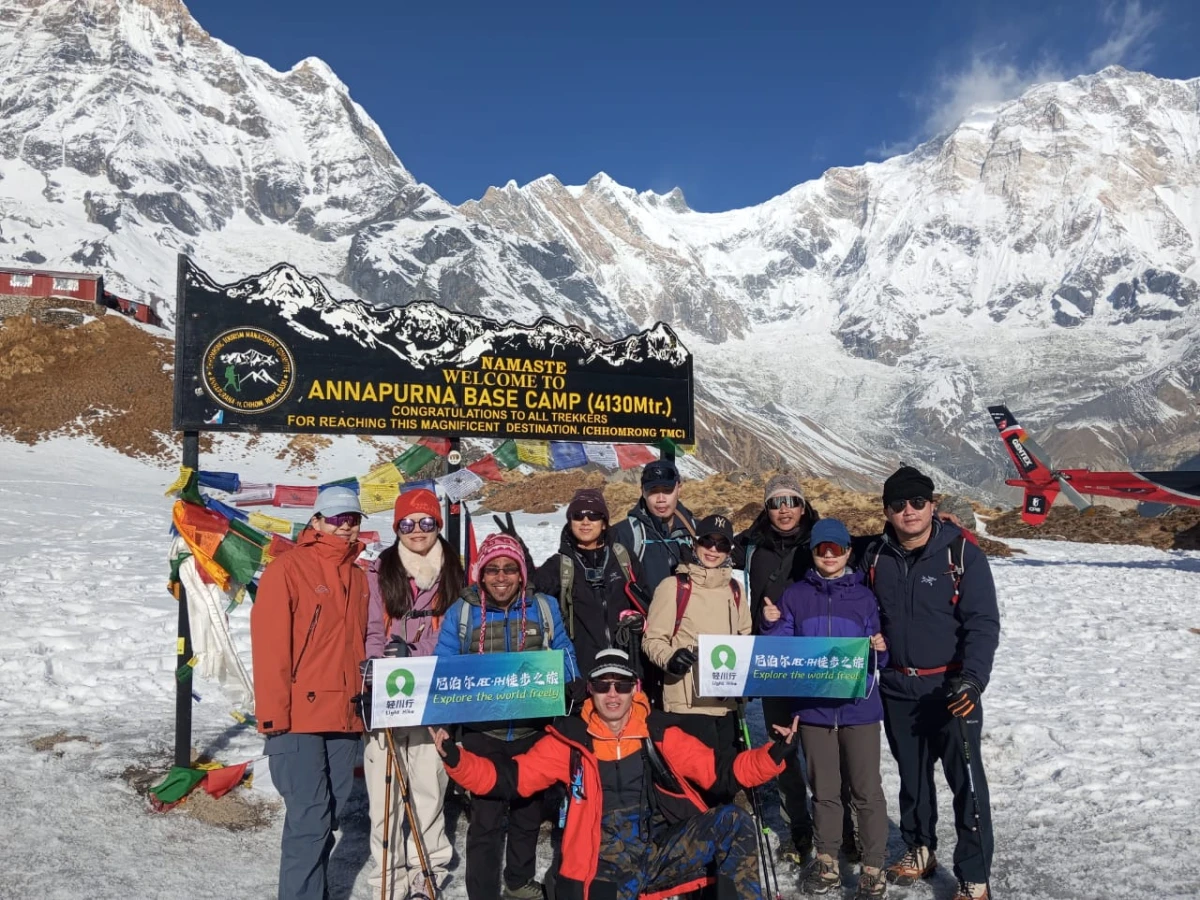
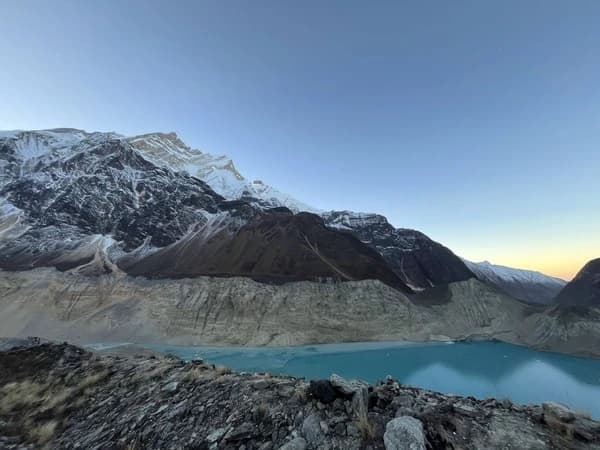
The Base Camp Amphitheater: Arriving at Annapurna Base Camp and standing in the center of the sanctuary is a spatial experience without parallel. Peaks above 7,000 meters encircle you on every side. Annapurna I's south face towers directly above. Machapuchare's perfect triangular profile guards the eastern approach. At sunset and sunrise, the light across these faces is extraordinary.
The Gurung Cultural Immersion: Unlike many Himalayan treks that pass through sparsely populated high-altitude terrain, this route threads through active Gurung communities that have lived on these slopes for centuries. In Ghandruk and Chhomrong, you walk past stone homes with slate roofs, observe traditional weaving on hand looms, and eat meals cooked in family kitchens. Our guides—several of whom are Gurung themselves—bridge the cultural gap with genuine warmth. For travelers from the United States, Canada, Australia, and the UK, these village encounters often become the most treasured memories, surpassing even the mountain views.
The Rhododendron Forest Corridor: Between Ghorepani and Tadapani, the trail passes through one of the finest rhododendron forests in the eastern Himalayas. In spring—late March through early May—these forests erupt in color: scarlet, pink, magenta, and white blooms layered against moss-draped branches and filtered mountain light. Nature enthusiasts from France, Belgium, and the Netherlands find this section particularly rewarding.
Why This Package Outperforms Competitors
The Annapurna Base Camp route is offered by hundreds of operators in Nepal. Most sell on price. Few sell on quality, safety infrastructure, or decades of expertise. Here is where our package creates distance from the field.
Competitor Comparison Table
|
Feature
|
View Nepal Treks & Expedition
|
Typical Budget Operator
|
International Booking Platform
|
|
Years of Operation
|
20+ years
|
2–5 years
|
Marketplace (varies)
|
|
Guide Certification
|
NATA-licensed, first aid trained
|
Often unlicensed freelancers
|
No verification standard
|
|
Guide-to-Trekker Ratio
|
1:6 maximum
|
1:12 or higher
|
Unspecified
|
|
Acclimatization Schedule
|
Medically informed altitude gain
|
Rushed to save days
|
Varies by vendor
|
|
Emergency Evacuation Plan
|
Documented, insured, helicopter-on-call
|
Ad hoc, often uninsured
|
Operator-dependent
|
|
Teahouse Selection
|
Pre-vetted for hygiene and comfort
|
Cheapest available
|
Unspecified
|
|
Permit Handling
|
All permits included, pre-arranged
|
Often added as hidden fee
|
Often excluded
|
|
Porter Wages
|
Above Nepali minimum, insured
|
Frequently underpaid
|
No transparency
|
|
Post-Trip Support
|
24/7 Kathmandu office, review follow-up
|
Minimal
|
Platform-mediated only
|
Travelers from Germany, Switzerland, the Netherlands, and Scandinavia frequently ask about ethical employment practices—porter insurance, fair wages, and working conditions. These are foundational policies in our operation, audited annually.
Who This Package Is Perfect For
The 10-day Annapurna Base Camp trek suits a wide range of travelers, but it is not for everyone. Here is an honest assessment.
Ideal for: Fit adults with a regular exercise routine who want a challenging but non-technical Himalayan experience. Prior trekking experience is helpful but not mandatory. We regularly guide first-time trekkers from the United States, Canada, the UK, Ireland, and Australia who have prepared with three to four months of cardio and hill training. The trek also suits experienced hikers from alpine countries—Austria, Switzerland, Norway—who want to test fitness at Himalayan altitude.
Age range: We have guided trekkers from 16 to 72 on this route. Fitness, not age, is the determining factor.
Not ideal for: Anyone with serious cardiovascular or respiratory conditions, those unwilling to walk five to seven hours daily on uneven terrain, or travelers who require hotel-standard accommodation throughout.
Annapurna Base Camp Trek Cost: Full Pricing Breakdown
The cost of the Annapurna Base Camp trek varies significantly depending on what is included. Budget operators in Kathmandu advertise prices as low as $400–500 per person, but these typically exclude permits, domestic transport, Kathmandu and Pokhara hotels, most meals, and insurance. The actual out-of-pocket cost ends up similar to—or higher than—a properly inclusive package.
Our 10-day package is priced to include everything a trekker needs from arrival in Kathmandu to departure, with no hidden fees.
Cost Breakdown Table: Inclusions
|
Item
|
Included in Package
|
Estimated If Booked Separately
|
|
Airport transfers (Kathmandu)
|
✓
|
$15–20
|
|
Hotel in Kathmandu (1 night, 3-star B&B)
|
✓
|
$40–60
|
|
Kathmandu to Pokhara transport
|
✓
|
$25–110 (bus/flight)
|
|
Hotel in Pokhara (2 nights, 3-star B&B)
|
✓
|
$40-50
|
|
Pokhara to Nayapul private vehicle
|
✓
|
$30–50
|
|
ACAP Permit
|
✓
|
$30
|
|
TIMS Card
|
✓
|
$20
|
|
Licensed English-speaking guide
|
✓
|
$25–35/day
|
|
Porter (1 per 2 trekkers, 15kg max)
|
✓
|
$20–25/day
|
|
Teahouse accommodation (7 nights)
|
✓
|
$5–15/night
|
|
All meals on trek (breakfast, lunch, dinner)
|
✓
|
$20–35/day
|
|
First aid kit & oximeter
|
✓
|
$20–40
|
|
Trek completion certificate
|
✓
|
—
|
|
Government taxes & service charges
|
✓
|
13% VAT
|
What Is Not Included
|
Item
|
Estimated Cost
|
|
International flights to/from Kathmandu
|
Varies by origin
|
|
Nepal tourist visa ($50 for 30 days)
|
$50
|
|
Travel insurance (mandatory, helicopter evacuation coverage)
|
$50–150
|
|
Personal snacks, drinks, and bar orders
|
$5–15/day
|
|
Hot showers at higher elevations
|
$2–4 per shower
|
|
Device charging above Chhomrong
|
$2–3 per charge
|
|
Tips for guide and porter
|
$80–150 total (customary)
|
|
Personal trekking gear purchases
|
Variable
|
Total Package Price: Contact us directly for current group departure and private trek pricing. Rates vary by season, group size, and accommodation tier. We provide fully transparent quotes with no hidden charges. Travelers from the United States, United Kingdom, Canada, Australia, and the EU benefit from direct bank transfer and credit card payment options.
Value Justification
When comparing the cost of the Annapurna Base Camp trek across operators, the critical question is not "who is cheapest?" but "what is actually included?" A $450 budget trek that excludes permits ($50), meals ($200+), city hotels ($150+), and internal transport ($100+) quickly climbs past $950 with inferior service. Our all-inclusive pricing eliminates financial surprises on the trail—and that peace of mind is worth every dollar, pound, euro, or franc.
Expert Travel Tips from 20+ Years of Guiding
Fitness Preparation
Begin training at least eight to twelve weeks before departure. The best preparation combines cardiovascular endurance (running, cycling, swimming) with leg strength (squats, lunges, step-ups) and hill walking with a loaded pack. If you live in a flat country—the Netherlands, Denmark, Singapore—use a stair-climbing machine or multi-story building to simulate vertical gain. Aim for the ability to walk uphill for four consecutive hours with a 5–8 kg daypack without significant fatigue.
A realistic weekly training plan might include three cardio sessions of 45–60 minutes, two strength sessions focused on legs and core, and one long weekend walk of three to five hours on hilly terrain with a weighted pack. Swimming is excellent cross-training for cardiovascular capacity without joint impact—particularly useful for trekkers from Australia and New Zealand who may already be active runners but need altitude-specific endurance. In the final two weeks before departure, taper intensity to arrive in Kathmandu rested rather than fatigued.
Mental preparation matters nearly as much as physical conditioning. The trek involves consecutive days of effort, basic accommodation, limited connectivity, and moments of genuine discomfort at altitude. Trekkers who approach these challenges with flexibility and curiosity rather than rigid expectations consistently have better experiences. We brief every client on this during the pre-trek meeting.
Altitude Sickness Awareness
Acute Mountain Sickness (AMS) can affect anyone above 2,500 meters regardless of fitness. Symptoms include headache, nausea, dizziness, and poor sleep. Our guides monitor trekkers twice daily using pulse oximeters and the Lake Louise AMS scoring system. The itinerary builds in appropriate altitude gain per day—never exceeding 600–800 meters of net gain above 3,000 meters—and allows the body to acclimatize naturally. Diamox (acetazolamide) is sometimes recommended as a prophylactic; consult your physician before departure.
The critical rule is simple: if you develop symptoms, do not ascend further until they resolve. If symptoms worsen, descend immediately. Our guides are trained to make this call decisively, even if it means adjusting the itinerary. In twenty-plus years, we have never had a serious altitude incident on this route—a record we maintain through conservative scheduling and aggressive early intervention. Hydration is the single most effective preventive measure: aim for three to four liters daily above 2,500 meters, supplemented with electrolyte sachets.
Packing Smart
Overpacking is the most common mistake, particularly among first-time trekkers from the United States and Canada. Your porter carries up to 15 kilograms, and your daypack should weigh no more than 5–6 kilograms with water, camera, rain layer, and warm layer.
Equipment and Packing List Table
|
Category
|
Essential Items
|
Notes
|
|
Footwear
|
Broken-in waterproof trekking boots, camp sandals
|
Ankle support critical; never trek in new boots
|
|
Layers – Base
|
2–3 moisture-wicking base layers (merino or synthetic)
|
Avoid cotton entirely
|
|
Layers – Mid
|
Fleece jacket or softshell, lightweight down jacket
|
Down jacket essential above 3,000m
|
|
Layers – Outer
|
Waterproof/breathable shell jacket and pants
|
Gore-Tex or equivalent
|
|
Lower Body
|
2 pairs trekking pants, thermal leggings
|
Convertible pants practical
|
|
Head & Hands
|
Warm beanie, sun hat, liner gloves, insulated gloves
|
Two layers of hand protection for ABC morning
|
|
Accessories
|
UV-rated sunglasses, sunscreen SPF50, lip balm with SPF
|
High-altitude UV is extreme
|
|
Sleeping
|
3-season sleeping bag rated to −10°C or liner
|
Rental available in Kathmandu or Pokhara
|
|
Hydration
|
2 x 1-litre water bottles or hydration bladder
|
Purification tablets or SteriPEN recommended
|
|
Electronics
|
Headlamp (spare batteries), power bank 20,000mAh+
|
Charging unreliable above Chhomrong
|
|
Daypack
|
30–35 litre with rain cover
|
Hip belt distributes weight
|
|
Documents
|
Passport, insurance policy, 4x passport photos, cash (NPR & USD)
|
ATMs only in Pokhara
|
|
Medical
|
Personal medications, blister kit, Diamox (if prescribed), rehydration salts
|
Declare all medications to your guide
|
Money and Connectivity
Withdraw sufficient Nepali rupees in Pokhara before the trek. ATMs do not exist on the trail. Teahouse purchases are cash-only. Budget $10–20 per day for personal expenses. Mobile coverage (Ncell network) is intermittent above Chhomrong and largely absent in the sanctuary. Wi-Fi is available at some teahouses for a fee but is slow and unreliable above 3,000 meters.
Travel Insurance
Annapurna Base Camp travel insurance must cover trekking up to 5,000 meters and helicopter evacuation. This is non-negotiable. Helicopter rescue from the sanctuary to Pokhara costs $3,000–5,000 without insurance. Companies like World Nomads, Global Rescue, and Allianz offer appropriate policies for trekkers from the United States, United Kingdom, Canada, Australia, and the EU. Verify your policy covers Nepal, the specific altitude, and emergency evacuation before departure.
Safety, Visa, and Local Regulations
Trekking Permits
Two permits are required for the Annapurna Base Camp trek, and both are included in our package.
ACAP Permit (Annapurna Conservation Area Permit): NPR 3,000 for foreign nationals (approximately $23 USD). Issued by the National Trust for Nature Conservation. Funds conservation and community projects within the Annapurna Conservation Area.
TIMS Card (Trekkers' Information Management System): NPR 2,000 for trekkers with an organized agency (approximately $15 USD). Issued by TAAN. Functions as a trekker registration and safety tracking system.
Both permits are arranged by our office in Kathmandu or Pokhara. You need your passport and two passport-sized photographs.
Nepal Visa
Citizens of most countries—including the United States, United Kingdom, Canada, Australia, Germany, France, the Netherlands, Sweden, Norway, Denmark, Switzerland, Singapore, Japan, South Korea, and the UAE—can obtain a visa on arrival at Tribhuvan International Airport. A 30-day tourist visa costs $50 USD (cash). Alternatively, apply online through Nepal's Department of Immigration website before departure.
Is the Annapurna Base Camp Trek Safe?
With proper preparation, appropriate acclimatization, and an experienced guide, the trek is considered safe for healthy adults. The primary risks are altitude sickness (mitigated by our acclimatization schedule and twice-daily monitoring), weather changes (mitigated by flexible itinerary management), and trail hazards such as stone steps and river crossings (mitigated by guide expertise). Avalanche risk in the upper sanctuary exists during and after heavy snowfall, primarily in winter and early spring. Our guides assess conditions daily and modify the route when necessary.
Trekking Without a Guide
Since 2023, Nepal requires all foreign trekkers in restricted and national park areas to trek with a licensed guide. The Annapurna Conservation Area falls under this regulation. Independent solo trekking without a guide is no longer permitted by Nepali law. This rule exists for safety—trail navigation, weather assessment, altitude monitoring, and emergency communication are all dramatically better with an experienced local guide.
Prior to the regulation, incidents involving solo trekkers who lost trails, developed unmonitored altitude sickness, or were stranded by weather changes were regrettably common. For experienced hikers from alpine nations like Switzerland, Austria, and Norway who are accustomed to independent mountain travel, the guide is not a constraint—it is an enhancement. Our guides provide route knowledge, cultural context, language skills, and emergency capability that no GPS device or guidebook can replicate.
Trail Conditions and Terrain
The trail is well-established but should not be confused with maintained paths in European or North American parks. Expect rough stone steps—thousands of them—uneven rocky paths, narrow hillside sections, and occasional stream crossings. Trekking poles are strongly recommended, particularly on descent days. After rainfall or snowmelt, sections between Bamboo and Deurali can be muddy. The path is well-marked with painted arrows and teahouse signs, but river crossings and avalanche debris above Deurali can temporarily obscure the route—another reason a licensed guide is essential.
Seasonal Comparison: Best Time for the Annapurna Base Camp Trek
The Annapurna region experiences four distinct trekking seasons. Each has genuine advantages and trade-offs. We operate treks in all seasons and advise based on your priorities.
Seasonal Comparison Table
|
Season
|
Months
|
Temp at ABC
|
Visibility
|
Trail Traffic
|
Conditions
|
Verdict
|
|
Autumn (Peak)
|
Oct–Nov
|
−5 to 5°C
|
Excellent
|
High
|
Stable, dry, clear skies
|
Best overall
|
|
Spring (Peak)
|
Mar–May
|
−3 to 8°C
|
Good to Excellent
|
High
|
Rhododendron blooms, afternoon cloud
|
Best for flora
|
|
Winter
|
Dec–Feb
|
−15 to −5°C
|
Excellent (clear)
|
Very Low
|
Cold, possible snow above 3,000m, some teahouses closed
|
Best for solitude
|
|
Monsoon
|
Jun–Sep
|
2 to 12°C
|
Poor (clouds, rain)
|
Very Low
|
Heavy rain, leeches, trail erosion
|
Not recommended
|
Autumn (October–November) is the gold standard. Stable high-pressure systems deliver clear skies day after day, temperatures are comfortable for walking, and post-monsoon air clarity produces the sharpest mountain views. The trade-off is trail traffic—teahouses fill quickly and popular viewpoints can feel crowded.
Spring (March–May) matches autumn for views in March and early April, with the added spectacle of rhododendron forests in full bloom. Afternoon clouds build as the season progresses toward monsoon, sometimes obscuring high peaks by midday. Temperatures are slightly warmer than autumn.
Winter (December–February) is for experienced trekkers who want solitude and are equipped for cold. The Annapurna Base Camp trek in winter offers crystalline visibility and empty trails, but temperatures at 4,130 meters drop well below minus ten at night. Snowfall above 3,000 meters may require microspikes. Some teahouses between Deurali and ABC close in deep winter.
Monsoon (June–September) is least favorable. Heavy rainfall, active leeches in forest zones, reduced visibility, and trail erosion make the experience challenging. The trek in monsoon is possible but only recommended for those with flexible schedules and high tolerance for wet conditions.
Difficulty Assessment: How Hard Is the Annapurna Base Camp Trek?
The trek is rated moderate to moderately strenuous. It does not require technical climbing skills, rope work, or mountaineering experience. The challenges are sustained daily walking on uneven terrain, significant cumulative elevation gain and loss, and sleeping at altitude up to 4,130 meters.
Difficulty Comparison Table
For beginners: the difficulty is manageable with proper physical preparation. The key factors are cardiovascular fitness, leg strength, and mental resilience for consecutive days of walking. If you can comfortably hike uphill for four hours with a daypack, you have a solid foundation. Our guides adjust the pace to the group and provide encouragement and altitude coaching throughout.
Booking Process
Booking with View Nepal Treks & Expedition follows a simple, transparent process designed for international travelers.
Step 1 – Inquiry: Contact us via email, WhatsApp, or the inquiry form on our website. Share your preferred dates, group size, and any special requirements (dietary, medical, equipment rental, helicopter return).
Step 2 – Custom Quote: We respond within 24 hours with a detailed, itemized quote. No hidden fees. Every cost listed.
Step 3 – Confirmation: A 25% deposit secures your booking. We accept bank transfer, credit card (Visa/Mastercard), and PayPal. Balance due upon arrival in Kathmandu.
Step 4 – Pre-Trip Preparation: We send a comprehensive preparation guide covering fitness training, gear recommendations, visa instructions, insurance requirements, and a packing checklist. Our team is available for questions throughout your preparation period.
Step 5 – Arrival: Our airport representative meets you at Kathmandu airport. From that moment, every logistical detail is handled.
Group Departures vs. Private Treks
We offer both scheduled group departures and fully private treks. Group departures run on fixed dates throughout peak seasons—typically two to three per month in October, November, March, and April—and offer lower per-person cost by sharing guide and transport expenses across four to twelve trekkers. Private treks start on any date with complete customization.
Solo travelers from Sweden, Finland, Luxembourg, and Ireland often prefer group departures for the social dimension. Couples and families from the United States, Canada, Australia, and the UAE more frequently choose private departures for flexibility.
Cancellation and Flexibility
Our policy is designed to be fair: full refund minus bank fees for cancellations more than 30 days before departure, 50% refund for 15–30 days, and no refund within 14 days. We strongly recommend travel insurance with trip cancellation coverage. Date changes are accommodated at no additional charge when possible, subject to availability.
Book Your Annapurna Base Camp Trek with Confidence
You have read the itinerary. You understand the altitude profile, the costs, the seasonal windows, and the preparation required. Now the decision is simple: do you want to see the Annapurna Sanctuary for yourself?
View Nepal Treks & Expedition has been guiding this route for more than twenty years. We know every stone step between Nayapul and base camp. We know which teahouse cooks the best dal bhat in Chhomrong. We know how to read the weather rolling over Machapuchare. That knowledge—earned across thousands of trekking days in the Annapurna region—is what you book when you choose us.
Contact us today for a personalized quote. Whether you are a solo traveler from New York, a couple from London, a group of friends from Sydney, or a family from Munich, we build the trek around your needs.
Ready to Trek? Email: [email protected] | WhatsApp: +977-9851029611 Request your free, no-obligation quote within 24 hours. 20+ years of Himalayan expertise. Thousands of satisfied trekkers. Your adventure starts here.