Mardi Himal Trek - 11 Days

Mardi Himal Trek - 9 Days

Customize Trip
Trip at a Glance
Duration11 Days
Trip GradeModerate
CountryNepal
Maximum Altitude4600m
Group Size2-20
StartsKathmandu
EndsKathmandu
ActivitiesTrekking
Best TimeSpring and Autumn

Trek Overview Mardi Himal Trek

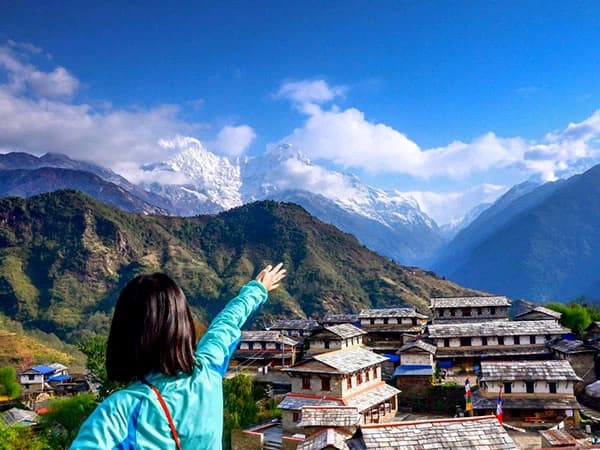
The Mardi Himal Trek is one of those rare Himalayan routes that rewards every step without demanding extreme endurance or prior high-altitude experience. Over 11 days, this trek takes you from the lakeside city of Pokhara through dense rhododendron forests, past alpine meadows, and up to a ridge-top viewpoint at 4,500 meters where the Annapurna Range, Machapuchare (Fishtail), Hiunchuli, and the distant peaks of Dhaulagiri spread across the horizon like a wall of ice and rock.

We have been operating treks in the Annapurna region for more than two decades. During that time, we have guided thousands of trekkers from the United States, United Kingdom, Canada, Australia, Germany, Switzerland, France, the Netherlands, and Scandinavian countries along this route. We have watched the Mardi Himal trail evolve from an obscure shepherd's path into one of Nepal's most sought-after trekking experiences, and we have refined every aspect of this 11-day package to match the expectations of international trekkers who demand safety, comfort, and authenticity.

This is not a mass-market itinerary copy-pasted from another operator's website. This is a field-tested, altitude-calibrated, and culturally immersive program designed by a team that has physically walked every meter of this trail in every season.

Highlights

  • Stunning views of the Annapurna range, including Machhapuchhre (Fishtail) and Mardi Himal itself.
  • Trek through lush forests, rhododendron blooms (in spring), and quaint villages.
  • Mardi Himal sees fewer trekkers, providing a more serene experience amidst nature.
  • Interact with local villagers, predominantly Gurung and Magar communities.
  • Experience unique culture, traditions, and lifestyle.
  • The trek encompasses diverse landscapes, from terraced fields to dense forests and alpine meadows.
  • spectacular panoramic views of surrounding peaks and glaciers.
  • A rewarding experience to reach the base camp and witness the breathtaking scenery.
  • Explore a relatively untouched part of the Annapurna region.
  • High Camp or Badal Danda for even more panoramic views or cultural experiences.

About View Nepal Treks & Expedition – 20+ Years on Himalayan Trails

View Nepal Treks & Expedition was established with a single purpose: to give international travelers a genuine, safe, and deeply informed trekking experience in Nepal. Over more than 20 years, we have built a reputation that rests on three pillars — expert route knowledge, uncompromising safety standards, and guides who treat every client like family.

Our founding team includes veterans who started as porters, became guides, earned mountaineering certifications, and eventually became trek planners. That ground-up experience means every recommendation in this itinerary comes from firsthand knowledge, not from a research desk. When we say the water source at High Camp freezes by late November, we know it because our guides have melted snow there. When we advise trekkers from Singapore or the UAE to add an extra acclimatization day, it is because we have observed how rapid altitude transitions affect people arriving from sea-level climates.

We hold all required licenses from the Nepal Tourism Board and the Department of Tourism. Our guides carry Wilderness First Responder certifications. We maintain emergency communication equipment on every trek. We are members of the Trekking Agencies' Association of Nepal (TAAN), and our operations are fully insured for client evacuation.

Our client base spans more than 40 countries, with particularly strong repeat-booking rates from trekkers in the United States, Canada, the United Kingdom, Australia, Germany, Switzerland, Norway, Sweden, Denmark, and the Netherlands. We also serve growing numbers of trekkers from Ireland, New Zealand, Austria, Belgium, Luxembourg, Finland, Italy, Spain, South Korea, Japan, and the United Arab Emirates.

Deep Destination Guide – The Annapurna Region and the Mardi Himal Route

Understanding the Mardi Himal Trail

The Mardi Himal Base Camp sits at an altitude of approximately 4,500 meters (14,763 feet) on a prominent ridge extending south from Mardi Himal (5,587 m), a satellite peak of the Machapuchare massif. Unlike the more frequented Annapurna Base Camp trail, the Mardi Himal route follows a ridge-line trajectory rather than a river valley, which means you gain elevation through forest and alpine grassland rather than through narrow gorges.

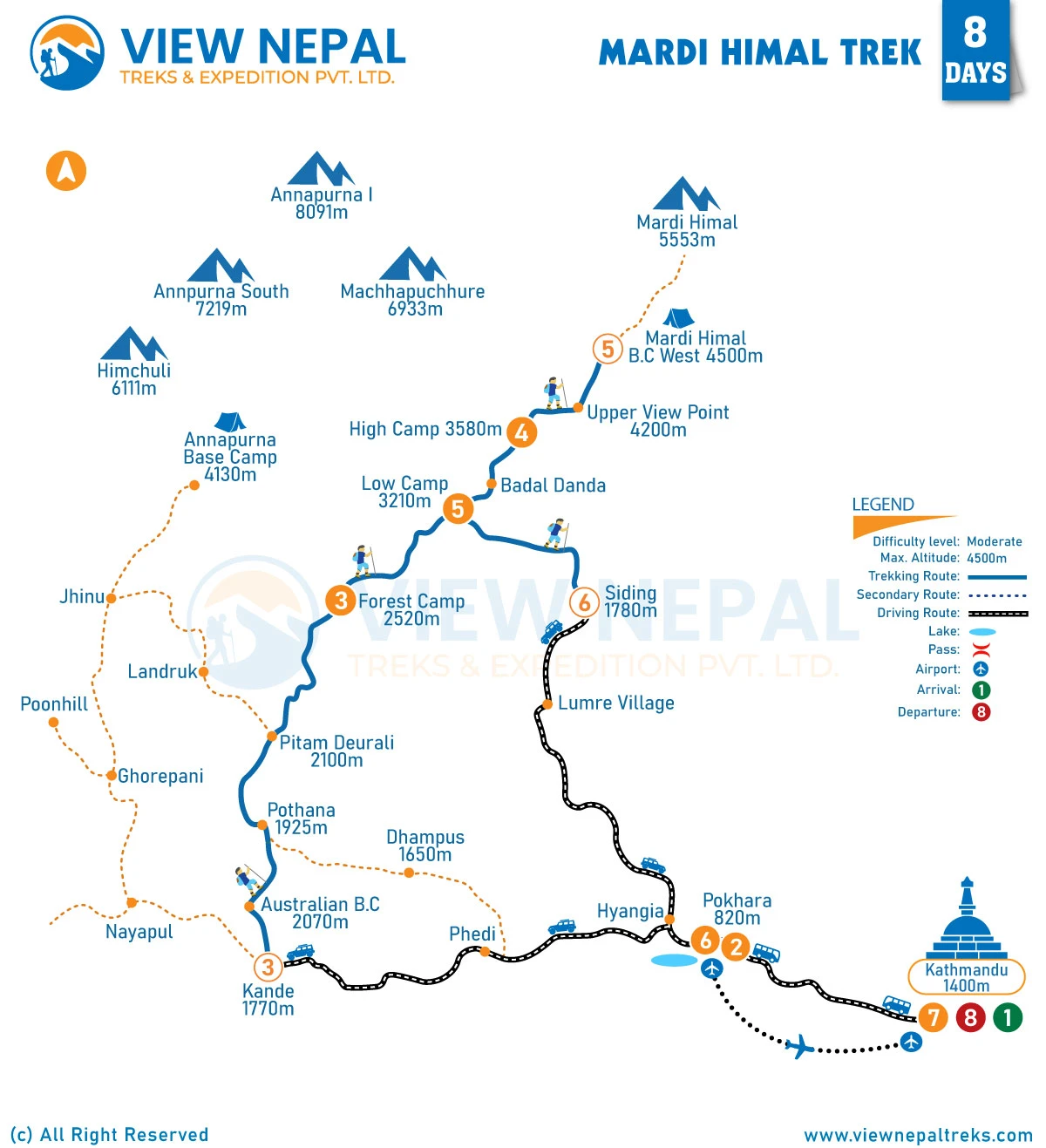
The trek distance covers roughly 58 to 65 kilometers depending on the exact route variation and side excursions. The trail begins at Kande (approximately 1,770 m), a roadhead about 45 minutes by vehicle from Pokhara, and ascends through Forest Camp (2,520 m), Low Camp (2,990 m), Badal Danda (3,210 m), and High Camp (3,580 m) before reaching the base camp viewpoint.

This route falls entirely within the Annapurna Conservation Area, managed under the Annapurna Conservation Area Project (ACAP). Trekkers require an ACAP permit and a Trekkers' Information Management System (TIMS) card, both of which we arrange as part of our package.

Why Mardi Himal Over Other Annapurna Treks

The Mardi Himal trek occupies a sweet spot in Nepal's trekking landscape. It is more intimate and less crowded than the Annapurna Base Camp trek, but offers comparable — many would argue superior — panoramic views. The ridge-top position at Mardi Himal Base Camp delivers an unobstructed 270-degree Himalayan panorama that few other accessible viewpoints in the Annapurna region can match.

For trekkers from countries like the United States, Canada, Australia, and European nations who have limited holiday time, the 11-day duration (including Kathmandu and Pokhara days) is practical. You are not committing three or four weeks as you would for the Annapurna Circuit. You are investing 11 well-structured days and returning home with memories and photographs that rival any longer expedition.

Mardi Himal vs Annapurna Base Camp – A Direct Comparison

Factor

Mardi Himal Trek (11 Days)

Annapurna Base Camp Trek (12-14 Days)

Maximum Altitude

~4,500 m

~4,130 m

Trail Crowd Level

Low to Moderate

High

Panoramic Scope

270-degree ridge-top view

Valley-enclosed amphitheater

Terrain Variety

Forest, ridge, alpine meadow

River valley, stone steps, moraine

Teahouse Quality

Basic to moderate

Well-established

Permit Requirements

ACAP + TIMS

ACAP + TIMS

Best For

Solitude seekers, photographers

Classic Himalayan trekkers

Fitness Requirement

Moderate

Moderate

Machapuchare View

Dramatic east face close-up

South face from a distance

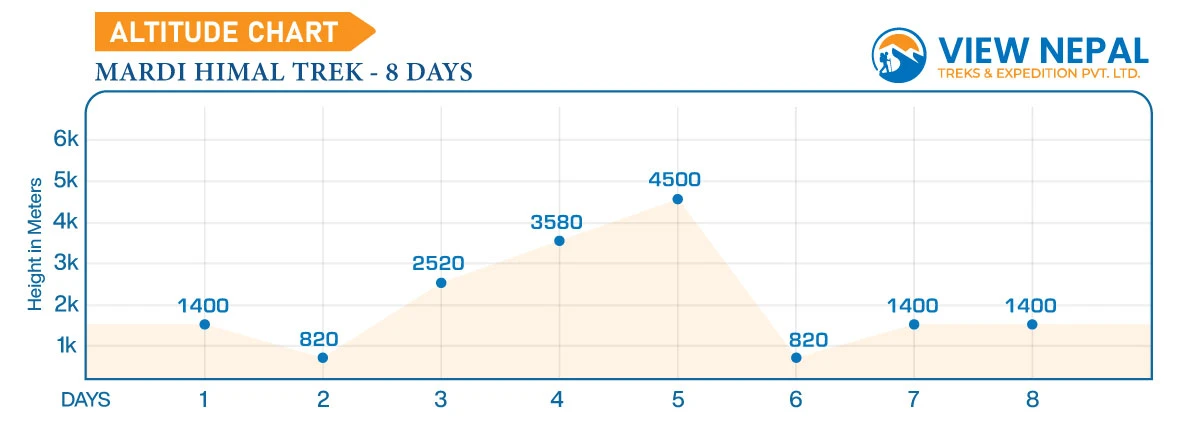
Day-by-Day Altitude Gain Table

Day

Route

Start Altitude

End Altitude

Net Altitude Gain

Walking Hours

Difficulty

Day 1

Arrival in Kathmandu

1,400 m

Easy

Day 2

Fly from Kathmandu to Pokhara

1,400 m

827 m

-573 m

Easy

Day 3

Drive to Kande, Trek to Forest Camp

1,770 m

2,520 m

+750 m

4–5 hrs

Moderate

Day 4

Forest Camp to High Camp

2,520 m

3,580 m

+1,060 m

5–6 hrs

Moderate–Strenuous

Day 5

Trek to Mardi Himal Base Camp, View Point then Descend to Low Camp

3,580 m

4,500 m / 3,210 m

+920 m / -1,290 m

6–7 hrs

Strenuous

Day 6

Trek to Siding Village and Drive to Pokhara

3,210 m

827 m

-2,383 m

4–5 hrs trek + drive

Moderate

Day 7

Drive or Fly from Pokhara to Kathmandu

827 m

1,400 m

+573 m

25 min flight / 6–7 hrs drive

Easy

Day 8

Final Departure – Return from Tribhuvan International Airport, Kathmandu

1,400 m

Easy

Itinerary

Detailed Day-by-Day Itinerary – Mardi Himal Trek 11 Days

This itinerary has been refined over hundreds of departures. Every overnight stop, lunch halt, and rest point has been selected based on altitude gain management, teahouse quality, and scenic value. The altitude gain per day is calibrated to international standards for safe acclimatization.

Trip PlanExpand all

Your journey begins the moment you land at Tribhuvan International Airport. Our airport representative meets you at the arrival gate with a signboard bearing your name and transfers you to your hotel in the Thamel district. Depending on your arrival time, you may have a few hours to explore the narrow lanes of Thamel, visit the nearby Kathmandu Durbar Square, or simply rest after your international flight.

In the evening, we hold a pre-trek briefing at the hotel. This is not a perfunctory meeting — our trek leader walks through the entire route, discusses gear, answers altitude-related questions, checks your travel insurance details, and ensures every trekker understands what to expect. For trekkers arriving from sea-level countries such as Singapore, the UAE, the Netherlands, or Denmark, we pay particular attention to altitude awareness.

Welcome dinner included.

Hotel in Kathmandu.

Meals: DinnerAccommodation: Hotel

The 25-minute flight from Kathmandu to Pokhara is one of the most scenic short-haul flights in the world. On a clear day, you can see Manaslu, the Annapurna range, and Machapuchare from your aircraft window. Upon arrival in Pokhara, we transfer you to a lakeside hotel.

The afternoon is yours. Pokhara is a city built for travelers — you can walk along Phewa Lake, take a boat ride, visit the International Mountain Museum, or browse the shops along Lakeside Road. We recommend this as an active rest day to shake off any remaining jet lag before the trek begins.

For those who arrive a day early or want additional acclimatization, we can arrange a half-day sightseeing tour of Pokhara including the World Peace Pagoda and the Devi's Fall.

Hotel in Pokhara.

Max Altitude: 827m Meals: Breakfast, Lunch, DinnerAccommodation: HotelDuration: 6-7hours,20-30minutes(Flight)Distance: 200km

The trek begins in earnest. We drive about 45 minutes from Pokhara to Kande, the trailhead on the Pokhara-Baglung Highway. From Kande, the trail enters immediately into forest — a thick canopy of rhododendron, oak, and bamboo. The path ascends steadily through Deurali before reaching Forest Camp, a small cluster of teahouses set among towering rhododendrons.

This first trekking day is deliberately kept to a moderate 4-5 hours to let your body adjust to trail walking. The 750-meter altitude gain is manageable for anyone with reasonable fitness.

If you are trekking during March or April, the rhododendron forests along this stretch will be in full bloom — reds, pinks, and whites carpeting the hillside. It is one of the finest natural displays in the entire Annapurna trekking region.

Max Altitude: 2100m Meals: Breakfast, Lunch, DinnerAccommodation: LodgeDuration: 1-2hour,3-4hoursDistance: 42km,13-15km

Today's trek continues through dense forest before the canopy begins to thin and alpine scrub takes over. The trail is well-defined but involves some steeper sections as you gain elevation along the ridge. High Camp is a basic but comfortable stop with teahouses offering warm food and tea.

The altitude gain today is just 470 meters over 3-4 hours, which is ideal for acclimatization. You will notice the air becoming noticeably cooler, and the views beginning to open through the thinning forest. On clear afternoons, you catch your first unobstructed glimpses of Machapuchare's east face — a sight that stops most trekkers in their tracks.

Max Altitude: 2250m Meals: Breakfast, Lunch, DinnerAccommodation: lodgeDuration: 4-5hoursDistance: 7-8km

Day five is the most exciting and rewarding stage of the Mardi Himal Trek itinerary, as trekkers make their way to the highest point of the journey—Mardi Himal Base Camp. The day begins early from High Camp, when the sky is usually clear and the Himalayan peaks glow in the soft morning light.

The trail climbs steadily along a narrow alpine ridge, offering spectacular views of the Annapurna region. As you continue upward, the landscape changes noticeably. This is where trekkers fully leave the forest zone and enter the open high-altitude grassland above the treeline. Dense rhododendron forests disappear behind you, replaced by exposed ridges, rocky paths, and wide Himalayan panoramas stretching in every direction.

The walk from High Camp to Mardi Himal View Point is gradual but rewarding. From the viewpoint, the scenery becomes even more dramatic. Machhapuchhre (Fishtail) rises sharply above the ridge, appearing incredibly close, while Annapurna South and Hiunchuli dominate the western skyline. The Mardi Himal View Point is one of the best locations along the trek to appreciate the raw beauty of the Mardi Himal trekking route.

From the viewpoint, the trail continues upward toward Mardi Himal Base Camp (approximately 4,500 m). The final stretch is slightly steeper but short, and the sense of achievement upon reaching the base camp makes the effort worthwhile. Standing at Mardi Himal Base Camp, trekkers are surrounded by towering Himalayan peaks, with one of the closest and most impressive views of Machhapuchhre anywhere in Nepal. This moment is often considered the highlight of the entire Mardi Himal Base Camp Trek.

After spending some time enjoying the views, taking photographs, and celebrating the accomplishment, the trek begins the descent along the same ridge trail back to High Camp. After a short rest or lunch break, the journey continues downhill toward Low Camp (3,210 m).

The descent gradually brings trekkers back toward greener terrain. As the altitude drops, the air becomes richer in oxygen and the environment feels noticeably warmer. The trail eventually re-enters the alpine forest zone before reaching Low Camp, where trekkers spend the night in a comfortable teahouse after a long and unforgettable day in the high Himalayas.
This day is often remembered as the highlight of the Mardi Himal Trek in Nepal, combining the thrilling climb to Mardi Himal Base Camp, stunning views from Mardi Himal View Point, and a scenic descent back to Low Camp.

Max Altitude: 2990m Meals: Breakfast, Lunch, DinnerAccommodation: LodgeDuration: 2-3hoursDistance: 5km

The walk to High Camp is one of the most visually rewarding sections of the entire trek. You The final day of the Mardi Himal Trek itinerary begins with a scenic descent from the mountain ridges toward the lower hills of the Annapurna region. After several days spent in alpine landscapes and high-altitude terrain, the trail gradually leads trekkers back into lush forests and traditional mountain villages.

Leaving Low Camp (3,210 m) in the morning, the trail descends through beautiful rhododendron forests, moss-covered trees, and peaceful woodland paths. The air becomes warmer and richer with oxygen as you lose elevation, making the walk more comfortable after the previous high-altitude days of the Mardi Himal Base Camp Trek.

The route toward Siding Village is quieter than the main trekking trail, offering a more authentic glimpse into rural life in the hills below the Mardi Himal trekking route. Along the way, trekkers pass small farms, terraced fields, and scattered traditional houses belonging to local Gurung communities. The trail winds through forests and gentle slopes before gradually opening up to views of green hills and valleys stretching toward Pokhara Valley.

After several hours of descent, the trail reaches Siding Village, a peaceful settlement located on the southern slopes of the Mardi Himal Trek in Nepal. Unlike the busier trekking villages along the Annapurna routes, Siding offers a quiet and authentic atmosphere where trekkers can experience local mountain culture.

From Siding Village, a jeep or private vehicle transfer takes you on a scenic drive back to Pokhara, the beautiful lakeside city and starting point of the Mardi Himal Base Camp Trek. The drive typically takes about 2 to 3 hours, passing through winding mountain roads, terraced farmland, and small hillside villages.

Arriving in Pokhara, trekkers can finally relax after completing the unforgettable Mardi Himal Trek. The comfortable hotels, lakeside cafés, and stunning views of the Annapurna range reflected in Phewa Lake provide the perfect setting to celebrate the completion of the journey.

This final day marks the end of the Mardi Himal Trek itinerary, bringing trekkers from the remote mountain trails back to the vibrant lakeside city of Pokhara.

Max Altitude: 3580m Meals: Breakfast. Lunch, DinnerAccommodation: LodgeDuration: 2-3hoursDistance: 3-4km

After completing the incredible Mardi Himal Base Camp Trek, the final day of the Mardi Himal Trek itinerary is dedicated to returning from Pokhara to Kathmandu. This journey marks the official end of the Mardi Himal Trek in Nepal, giving trekkers time to relax and reflect on the unforgettable adventure in the Annapurna region.

The morning begins in the beautiful lakeside city of Pokhara, one of the most popular tourist destinations in Nepal. Many trekkers enjoy a peaceful breakfast near Phewa Lake, with stunning views of the Annapurna range and Machhapuchhre (Fishtail Mountain) visible in the distance. After days spent trekking through alpine ridges, high-altitude viewpoints, and remote villages along the Mardi Himal trekking route, returning to the comfort of Pokhara feels especially rewarding.

From Pokhara, travelers have two main options to return to Kathmandu. The most popular option is a scenic tourist bus drive from Pokhara to Kathmandu, which typically takes around 6 to 7 hours. The road follows the Prithvi Highway, passing through river valleys, terraced farmland, small roadside towns, and beautiful landscapes along the Trishuli River. This overland journey offers a final opportunity to enjoy Nepal’s diverse countryside after completing the Mardi Himal Trek.

For those who prefer a quicker and more comfortable journey, a domestic flight from Pokhara to Kathmandu is also available. The flight takes about 25 minutes and offers spectacular aerial views of the Himalayan mountains, including the Annapurna range, Manaslu, and Langtang Himal on clear days. Many trekkers choose this option to avoid the long drive and enjoy one last glimpse of the Himalayas from the air.

Upon arrival in Kathmandu, trekkers return to the vibrant capital city of Nepal. The city offers plenty of opportunities to celebrate the successful completion of the Mardi Himal Base Camp Trek, explore UNESCO World Heritage Sites, or enjoy local restaurants and markets in areas like Thamel.

The journey from Pokhara to Kathmandu officially concludes the Mardi Himal Trek itinerary, leaving trekkers with unforgettable memories of trekking through the spectacular landscapes of the Annapurna region, reaching Mardi Himal Base Camp, and experiencing the beauty of the Nepalese Himalayas.

Travel Options: Tourist Bus or Domestic Flight
 Drive Duration: 6–7 hours
 Flight Duration: Approximately 25 minutes
 Destination: Kathmandu, Nepal

Max Altitude: 4500m Meals: Breakfast, Lunch, DinnerAccommodation: LodgeDuration: 2-3hoursDistance: 3-4km

The final day of the Mardi Himal Trek itinerary marks the official conclusion of your unforgettable adventure in Nepal. After completing the Mardi Himal Base Camp Trek in the spectacular Annapurna region, it is time to prepare for your final departure from Kathmandu.

Most travelers spend their last morning in Kathmandu, Nepal’s vibrant capital city. Depending on your flight schedule, you may have time to enjoy a relaxed breakfast at your hotel or take a short walk around Thamel, the popular tourist district known for its trekking shops, cafés, and souvenir markets. Many trekkers use this time to reflect on the incredible journey through the Mardi Himal trekking route, from the peaceful rhododendron forests and alpine ridges to the breathtaking views from Mardi Himal Base Camp.

After breakfast, you will be transferred to Tribhuvan International Airport (Kathmandu International Airport) for your onward journey. The airport is the main international gateway to Nepal and serves travelers departing after completing famous Himalayan adventures such as the Mardi Himal Trek, Annapurna Base Camp Trek, and Everest Base Camp Trek.

Your airport transfer to Tribhuvan International Airport is usually arranged a few hours before your international flight departure to ensure a smooth check-in process. As you drive through the bustling streets of Kathmandu toward the airport, it’s the perfect moment to look back on the incredible experiences of trekking in the Nepal Himalayas.

The Mardi Himal Trek in Nepal is often remembered for its quieter trails, stunning mountain scenery, and close-up views of Machhapuchhre (Fishtail Mountain), Annapurna South, and Hiunchuli. From dense forests and traditional villages to high alpine viewpoints and the dramatic landscape near Mardi Himal Base Camp, the journey offers one of the most rewarding trekking experiences in Nepal.

Your departure from Tribhuvan International Airport Kathmandu brings the Mardi Himal Base Camp Trek itinerary to a close, but the memories of the Annapurna Himalayas, breathtaking sunrises, and the unique culture of Nepal will stay with you long after the trip ends.

We hope this journey inspires you to return to Nepal again for another Himalayan adventure.

Max Altitude: 1700m Meals: Breakfast, Lunch, DinnerAccommodation: LodgeDuration: 6-8hoursDistance: 14-15km
Unable to locate what you're seeking?Reach out to our travel experts.
Customize Trip
Cost Details
Includes
  • All arrival and departure transportation airport / hotel / airport.
  • Three Star (Tourist Standard) hotel in Kathmandu with bed / breakfast basis.
  • Pokhara hotel with breakfast as per itinerary
  • A guide who can speak English and government licensed.
  • Porter (2 clients: 1 porter).
  • Food in Trekking (B-L-D).
  • Lodge accommodation during trekking.
  • Applicable TIMS (Trekking Information Management Systems) card.
  • ACAP (Annapurna Conservation Area Project) permit.
  • Staff salary, food, insurance 
  • Transportation to Pokhara and back to Kathmandu with deluxe tourist bus before and after the trip
  • Pokhara - Trekking - Pokhara transportation by private vehicle 
  • Welcome or Farewell dinner in Kathmandu at authentic Nepalese restaurant with cultural programs.
  • Company service charge and Government tax
Excludes
  • Nepal Visa-International airfare-personal travel / medical insurance.
  • Drinks items (soft & hard), personal expenses and clothing.
  • Emergency evacuation by any means of transportation including Heli services and personal medical kit.
  • Tips for guide and porter.
  • Early return from the trip due to personal / medical problem in this case clients should bear his / her own expenses on return from trek and in Kathmandu including expenses of accompanying guide / porters
Essential Information

Accommodation and Quality Standards

Kathmandu and Pokhara Hotels

In both cities, we book three-star hotels with private bathrooms, hot water, Wi-Fi, and central locations. Our default hotels are in the Thamel area of Kathmandu and the Lakeside area of Pokhara. For trekkers who prefer upgraded accommodation, we offer four-star and boutique hotel options at a supplement.

For those interested in a Mardi Himal luxury lodge trek experience, we can arrange upgraded lodges where available, particularly in the lower sections of the route. However, above Low Camp, teahouse standards are uniform across all operators.

Teahouse Accommodation on the Trail

Teahouses along the Mardi Himal route range from well-built lodges at Forest Camp and Low Camp to basic shelters at High Camp. You can expect twin-sharing rooms with thin mattresses and blankets. Toilets are shared, and hot water is available at extra cost (or sometimes not at all above Badal Danda).

Accommodation Location

Room Type

Toilet

Hot Water

Charging

Wi-Fi

Kathmandu Hotel

Private double/twin

Attached

Yes

Yes

Yes

Pokhara Hotel

Private double/twin

Attached

Yes

Yes

Yes

Forest Camp Teahouse

Twin sharing

Shared

Available (paid)

Available (paid)

Limited

Low Camp Teahouse

Twin sharing

Shared

Available (paid)

Available (paid)

No

Badal Danda Teahouse

Twin sharing

Shared

Rarely

Limited

No

High Camp Teahouse

Twin sharing

Shared

No

Very limited

No

Food and Accommodation Standards

Mardi Himal trek food and accommodation is teahouse-style throughout the trail. Meals are prepared fresh in each teahouse kitchen. Typical menus include dal bhat (the Nepali staple of rice, lentils, and vegetables), noodle soups, fried rice, pasta, pancakes, and a variety of hot drinks. Portions are generous, and dal bhat comes with unlimited refills at most teahouses.

Water purification tablets or a filter bottle are recommended as bottled water is expensive at higher elevations and creates plastic waste. Our guides carry purification drops as a backup.

Unique Experiences on the Mardi Himal Trek

The Ridge Walk Above the Clouds

Unlike valley-bottom treks, the Mardi Himal route follows an open ridge from Badal Danda onward. You are literally walking above the cloud line on many mornings, with peaks rising around you and a sea of clouds filling the valleys below. This is an experience typically reserved for mountaineers, delivered here on a trekking trail accessible to fit beginners.

Machapuchare Up Close

No other accessible trek in Nepal brings you this close to the east face of Machapuchare (6,993 m). The "Fishtail" mountain is sacred and has never been officially summited. From the Mardi Himal ridge, its pyramidal shape dominates the sky, and at sunrise the east face catches the first light in shades of pink and gold.

Rhododendron Forests in Bloom

During the spring trekking season (March to May), the lower sections of the Mardi Himal trail pass through some of the finest rhododendron forests in the Himalayas. The national flower of Nepal, the rhododendron blooms in spectacular profusion at altitudes between 2,000 and 3,000 meters.

Cultural Immersion in Gurung Villages

The trail passes through or near several Gurung settlements. The Gurung people are one of Nepal's most culturally rich ethnic groups, with a tradition of Himalayan guiding and military service (Gurkha regiments). Interactions with local families and visits to small monasteries add a cultural dimension that distinguishes this trek from purely scenic routes.

Why This Package Beats Our Competitors

We have studied dozens of competing Mardi Himal trek packages offered by agencies in Nepal and internationally. Here is where our 11-day package stands apart.

Competitor Comparison Table

Feature

View Nepal Treks (This Package)

Typical Budget Operator

International Agency Reseller

Operator Experience

20+ years

2-5 years

Subcontracts locally

Guide Certification

Licensed, Wilderness First Responder trained

Licensed (basic)

Varies (unknown)

Group Size

Max 12

Up to 20+

Varies

Acclimatization Days

Built into itinerary

Often skipped

Depends on subcontractor

Emergency Equipment

Satellite phone, first aid, pulse oximeter

Basic first aid

Depends on subcontractor

Airport Transfers

All included

Often extra

Usually included

Pre-Trek Briefing

Detailed in-person session

Brief or none

Via email

Post-Trek Support

Certificate, photo sharing, review follow-up

None

Automated

Price Transparency

Full breakdown, no hidden costs

Hidden extras common

Marked up 40-80%

Mardi Himal Trek Cost

Competitive direct pricing

Slightly lower, fewer inclusions

Significantly higher

The Problem with 5-Day Mardi Himal Treks

Several operators now market a 5-day Mardi Himal trek that compresses the entire experience into an aggressive schedule. While this appeals to time-pressed travelers, it carries real risks. Skipping acclimatization days between 3,000 m and 4,500 m is medically inadvisable. The altitude gain per day on a 5-day schedule exceeds recommended limits, and the physical toll often robs trekkers of the energy needed to enjoy the base camp morning.

Our 11-day itinerary includes Kathmandu and Pokhara days that are essential for logistics, cultural experience, and physical adjustment. The actual trekking portion (Days 3-9) is seven days — a responsible timeframe that balances ambition with safety.

Who Mardi Himal Trek Is Perfect For

The Mardi Himal trek is a genuinely accessible Himalayan experience. It works well for:

First-time Himalayan trekkers who want a real mountain experience without the extreme commitment of Everest Base Camp or the Annapurna Circuit. If you can walk 5-7 hours a day on undulating terrain and handle some steep sections, you are fit enough.

Photographers and visual storytellers who want dramatic mountain compositions without the crowded viewpoints of more popular treks. The ridge-walk sections offer unobstructed angles that produce portfolio-quality images.

Couples and small groups seeking a more private and intimate trekking experience compared to the heavily trafficked trails of the Annapurna Sanctuary.

Solo travelers from countries like the United States, United Kingdom, Germany, Australia, and Canada who want the safety and companionship of a guided group without sacrificing flexibility.

Older trekkers and families with teenagers who are fit but prefer a moderate challenge. We have successfully guided trekkers in their late 60s on this route with proper pacing.

Corporate and team-building groups looking for a shared challenge in a spectacular setting.

Mardi Himal Trek Difficulty – An Honest Assessment

How difficult is the Mardi Himal trek?

This is one of the most common questions we receive.
The Mardi Himal trek difficulty is rated as moderate. It is not a walk in the park, but it is not a technical mountaineering challenge either. The primary difficulty factors are altitude (4,500 m at the highest point), trail steepness on certain sections, and exposure to cold weather above 3,000 m.

The Mardi Himal Trek is considered to be of moderate difficulty. While the trek does involve some steep ascents and descents, it is generally manageable for trekkers with a moderate level of fitness and some previous trekking experience. Altitude sickness is a potential risk, especially at higher elevations, so it's essential to acclimatize properly and take necessary precautions.

Difficulty Factor

Rating (1-5)

Notes

Altitude Challenge

3/5

Highest point 4,500 m; proper acclimatization mitigates risk

Daily Walking Distance

2/5

Average 5-6 hours per day; Day 7 is longest at 6-7 hours

Terrain Technicality

2/5

No ropes, no climbing; some exposed ridge sections

Physical Endurance

3/5

Cumulative fatigue builds over 7 trekking days

Weather Exposure

3/5

Cold above 3,000 m; wind on ridge sections; possible snow at High Camp

Overall Difficulty

Moderate

Suitable for fit beginners with preparation

Can beginners do the Mardi Himal trek? Yes — with conditions. A beginner should be able to walk 5-6 hours daily on hilly terrain, have basic cardiovascular fitness, and be willing to follow acclimatization protocols. We recommend at least 6-8 weeks of preparation before the trek, including regular hiking, stair climbing, and cardiovascular exercise.

Mardi Himal Trek Fitness Preparation

Start your Mardi Himal trek fitness preparation at least two months before departure. Here is what we recommend:

  • Walk or hike 3-4 times per week, gradually increasing distance and elevation gain
  • Include stair climbing or hill repeats twice a week
  • Add cardiovascular work (running, cycling, swimming) 2-3 times per week
  • Practice walking with a loaded daypack (5-8 kg) on weekend hikes
  • If you live in a flat country like the Netherlands, Denmark, or Singapore, use stair machines or indoor incline treadmills as terrain substitutes

Pricing Breakdown – Mardi Himal Trek Cost

Transparency matters. The Mardi Himal trek cost varies based on group size, season, accommodation preferences, and whether you fly or drive between Kathmandu and Pokhara.

Detailed Cost Breakdown Table

Cost Component

Included in Package

Notes

Airport transfers (Kathmandu)

Yes

Arrival and departure

Hotel in Kathmandu (2 nights)

Yes

3-star, breakfast included

Hotel in Pokhara (2 nights)

Yes

3-star, breakfast included

Kathmandu-Pokhara domestic flights (round trip)

Yes

Subject to schedule/weather

Ground transport to/from trailhead

Yes

Private vehicle

ACAP Permit

Yes

Annapurna Conservation Area

TIMS Card

Yes

Trekkers' Information Management System

Licensed English-speaking guide

Yes

Throughout trek

Porter service (1 porter per 2 trekkers)

Yes

Max 15 kg per trekker

All meals during trek (breakfast, lunch, dinner)

Yes

Days 3-9

Teahouse accommodation during trek

Yes

Twin sharing

First aid kit and safety equipment

Yes

Pulse oximeter, satellite phone

Government taxes and service charges

Yes


Pre-trek briefing

Yes


Trek completion certificate

Yes


International flights

No

Arrange independently

Travel insurance

No

Mandatory; must cover helicopter evacuation

Nepal visa fee

No

Available on arrival

Personal expenses (hot showers, charging, bar bills)

No

Approx. $5-15/day

Tips for guide and porter

No

Customary; budget $5-8/day total

Lunch and dinner in Kathmandu and Pokhara

No

Approx. $10-20/day

Hotel upgrades

No

Available on request

Extra activities in Pokhara or Kathmandu

No

Available on request

Mardi Himal Trek Price – What to Budget

The Mardi Himal trek cost through View Nepal Treks & Expedition starts from USD $850 per person for groups of 4 or more, and from USD $1,100 per person for solo trekkers. These prices are for the standard package as described above.

For comparison, international agencies typically charge $1,400 to $2,200 for the same route, as they add their own margins before subcontracting to local operators like us. Booking directly with us means you pay less and get more — direct communication, no middleman, and the assurance that your money supports the local team on the ground.

Inclusion / Exclusion Table

Included

Not Included

All domestic transportation within Nepal

International airfare

Hotel accommodation in Kathmandu and Pokhara

Travel insurance (mandatory)

All teahouse accommodation on trek

Nepal visa fee

All meals during trekking days

Personal expenses

Licensed trekking guide

Tips for guide and porters

Porter service

Meals in Kathmandu/Pokhara (except breakfast)

ACAP Permit and TIMS Card

Alcoholic and bottled beverages

Domestic flights (Kathmandu-Pokhara-Kathmandu)

Personal trekking gear

Airport pickup and drop-off

Emergency helicopter evacuation (covered by insurance)

Pre-trek briefing and trek completion certificate

Hotel upgrades

Expert Trekking Tips from 20+ Years on the Trail

Altitude Sickness – Prevention and Response

Altitude sickness (Acute Mountain Sickness, or AMS) is the single most important health concern on any Himalayan trek. On the Mardi Himal route, risk increases above 2,500 meters. Symptoms include headache, nausea, dizziness, loss of appetite, and difficulty sleeping.

Our prevention strategy is built into the itinerary: gradual altitude gain, adequate hydration, and a summit day structure that returns to a lower sleeping altitude. We monitor all trekkers twice daily using a pulse oximeter. If a trekker shows signs of AMS, our guide makes the call — descent is the treatment, and we do not hesitate to turn around when safety demands it.

We recommend that trekkers consult their physician about Acetazolamide (Diamox) before departure. It is widely used as a prophylactic for AMS and is available in Kathmandu pharmacies. However, it is not a substitute for proper acclimatization.

What to Pack – Mardi Himal Trek Packing List

Packing correctly can make or break your trekking experience. Our field-tested Mardi Himal trek packing list covers every essential without encouraging over-packing.

Category

Item

Notes

Base Layers

Moisture-wicking thermal top and bottom

Merino wool or synthetic

Mid Layers

Fleece jacket or insulated mid-layer

For evenings and higher camps

Outer Layer

Waterproof and windproof jacket

Gore-Tex or similar

Outer Layer

Waterproof trousers

For rain and snow

Insulation

Down jacket (rated to -10°C)

Essential above 3,000 m

Lower Body

Trekking trousers (2 pairs)

Quick-dry, not jeans

Footwear

Broken-in waterproof trekking boots

Ankle support essential

Footwear

Camp sandals or slippers

For teahouses

Socks

Trekking socks (3-4 pairs)

Merino wool preferred

Headwear

Warm beanie/hat

For cold mornings and High Camp

Headwear

Sun hat or cap

For daytime sun

Handwear

Insulated gloves or mittens

Windproof recommended

Accessories

Sunglasses (UV400, Category 3-4)

Essential for snow glare

Accessories

Trekking poles (pair)

Highly recommended for descent

Accessories

Headlamp with spare batteries

Essential for base camp morning

Bag

Daypack (25-35 liters)

For daily essentials

Bag

Duffel bag or trekking bag (50-60 liters)

Carried by porter

Bag

Dry bags or pack liners

Rain protection for gear

Hydration

Water bottles (2 x 1 liter) or hydration bladder

Plus purification tablets

Toiletries

Sunscreen SPF 50+, lip balm SPF, hand sanitizer

High-altitude sun is intense

Toiletries

Toilet paper and wet wipes

Not always available at teahouses

Health

Personal medications, blister kit, basic first aid

Diamox if advised by doctor

Tech

Camera, phone, power bank (20,000 mAh+)

Charging is limited above Low Camp

Documents

Passport, insurance policy, cash (Nepali rupees)

ATMs in Pokhara, not on trail

Mardi Himal Trek in Winter

Can you trek Mardi Himal in winter?

Yes, but with important caveats. The Mardi Himal trek in winter (December to February) offers crystalline skies and uncrowded trails, but temperatures at High Camp can drop to -15°C or below at night. Snow may cover the trail above Badal Danda, making navigation challenging. We run winter departures with experienced guides who know the snow conditions and carry appropriate equipment.

Winter trekkers should invest in four-season sleeping bags (or rent from us), high-quality insulated boots, and windproof layering systems. Microspikes or light crampons are advisable for icy sections.

Mardi Himal Trek in Monsoon

We do not recommend the Mardi Himal trek in monsoon season (June to August). Leeches are prevalent in the forest sections, trails become slippery and muddy, cloud cover obscures mountain views for most of the day, and the risk of landslides increases. If you must trek during this period, September is the best compromise — the rains are easing, forests are lush, and the trails are relatively quiet.

Seasonal Comparison – Best Time for Mardi Himal Trek

The best time for the Mardi Himal trek depends on your priorities: clear views, wildflowers, solitude, or budget savings.

Seasonal Comparison Table

Season

Months

Weather

Views

Crowds

Flora

Overall Rating

Autumn (Peak)

Oct-Nov

Clear skies, cool nights

Excellent

Moderate

Post-monsoon green

Best overall

Spring (Peak)

Mar-May

Warm days, occasional cloud

Very good

Moderate

Rhododendron bloom

Best for flowers

Winter

Dec-Feb

Cold, dry, crisp

Excellent (when clear)

Very low

Dormant

Best for solitude

Early Monsoon

Jun

Increasing rain

Cloudy

Very low

Lush green

Not recommended

Monsoon

Jul-Aug

Heavy rain, leeches

Poor

Minimal

Peak green

Not recommended

Late Monsoon

Sep

Decreasing rain

Improving

Low

Lush, clearing

Acceptable

The best month for the Mardi Himal trek is October, followed closely by November and then March-April. These months offer the optimal combination of stable weather, clear Himalayan views, and comfortable trekking temperatures.

For trekkers from the Northern Hemisphere (United States, Canada, United Kingdom, Germany, and Scandinavian countries), autumn aligns well with year-end holiday planning. Spring works well for those who can take time off in March or April. Trekkers from Australia and New Zealand often prefer February-March, which aligns with their late summer and early autumn.

Safety, Visa & Permits For Mardi HImal Trek

Is the Mardi Himal Trek Safe?

The Mardi Himal trek is safe when conducted with proper preparation, an experienced guide, and respect for mountain conditions. The primary safety considerations are altitude-related illness, trail exposure on the ridge section, cold-weather hazards, and occasional wildlife encounters (Himalayan langurs and, rarely, Himalayan black bears in the forest sections).

Our safety record over 20+ years reflects our commitment. We carry satellite communication devices, pulse oximeters, comprehensive first aid kits, and emergency evacuation insurance information for every trekker. Our guides are trained to recognize the early signs of AMS, HACE, and HAPE. We maintain a strict turnaround protocol — no summit view is worth risking a trekker's health.

Mardi Himal Trek Travel Insurance

Travel insurance is mandatory for this trek. Your policy must cover emergency helicopter evacuation up to an altitude of at least 5,000 meters, trip cancellation, and medical treatment in Nepal. We verify insurance details at the pre-trek briefing and will not permit trekkers to begin the trail without adequate coverage.

Recommended insurers with good Himalayan coverage include World Nomads, Global Rescue, and Allianz Travel. Trekkers from the United Kingdom, Germany, Switzerland, and other European countries may also have coverage through their national health systems or credit card benefits, but should verify high-altitude evacuation specifically.

Permits Required for Mardi Himal Trek

Two permits are required, both of which we arrange as part of our package.
ACAP Permit (Annapurna Conservation Area Project): NPR 3,000 for SAARC nationals; NPR 3,000 (approx. USD $23) for foreigners. This fee supports conservation efforts in the Annapurna region, including trail maintenance, reforestation, and wildlife protection.
TIMS Card (Trekkers' Information Management System): NPR 2,000 for organized trekkers (through registered agencies like us). This card registers your trekking route for safety and rescue coordination.

Can You Do the Mardi Himal Trek Without a Guide?

Technically, it is possible to trek Mardi Himal without a guide. However, we strongly advise against it for several reasons. The trail above Badal Danda can be unclear, especially in low visibility or snow. There is no mobile phone coverage above Low Camp. Altitude emergencies require immediate, informed response. And teahouse availability changes seasonally — a guide with current knowledge of which shelters are open can prevent you from being stranded.

Nepal's government has also been moving toward mandatory guide requirements for all trekking routes, and this regulation may be enforced on the Mardi Himal route in the near future.

Nepal Visa Information

Citizens of most countries can obtain a Nepal visa on arrival at Tribhuvan International Airport. As of the current fee schedule:

  • 15-day visa: USD $30
  • 30-day visa: USD $50
  • 90-day visa: USD $125

Bring a passport-sized photo and the exact fee in US dollars. Citizens of India do not require a visa. Citizens of some countries may need to apply in advance — check with the nearest Nepali embassy.

Booking Process – How to Reserve Your Mardi Himal Trek

Booking with View Nepal Treks & Expedition is straightforward:
Step 1: Inquiry. Contact us via our website, email, or WhatsApp with your preferred dates, group size, and any special requirements. We respond within 24 hours.
Step 2: Customization. We tailor the itinerary to your needs. Want an extra acclimatization day? Prefer to drive instead of fly between Kathmandu and Pokhara? Need a private room at teahouses where available? We accommodate.
Step 3: Confirmation. Once the itinerary is agreed, we send a booking confirmation with a detailed invoice. A 25% deposit secures your dates. The balance is payable upon arrival in Kathmandu or by bank transfer before departure.
Step 4: Pre-Trek Preparation. We send you a comprehensive preparation guide, including the packing list, fitness recommendations, insurance requirements, and visa information. Our team is available for questions via email or WhatsApp at any time.
Step 5: Arrive and Trek. We handle everything from airport pickup onward. You focus on the experience; we handle the logistics.

Best Time to Trek

The best time to undertake the Mardi Himal Trek is during the spring (March to May) and autumn (September to November) seasons. During these months, the weather is generally clear, and the skies are blue, offering the best views of the mountains. However, the trek can be done throughout the year, including the winter months, although the weather conditions may be colder and the views may be obscured by clouds.


Call to our expert 24/7
Bhupendra Adhikari
+977 9851029611
travelers choice
You May Also Like
Annapurna Base Camp Trek 10 Days
Starting From
US$730US$780
Annapurna Circuit Trek
Starting From
US$900US$1050
Annapurna Base Camp Trek
Starting From
US$650US$750
Need Help? Call Us.+977 9851029611