Langtang Gosaikunda Trek Overview
The Trek That Most Nepal Visitors Never Find — Until It's Too Late
Most trekkers who land in Kathmandu already have their minds made up: Everest Base Camp or Annapurna Circuit. Those are fine choices. But travelers who've done both — the ones who come back year after year — often tell us the same thing: the Langtang Gosaikunda Trek gave them something the bigger routes couldn't.
It's not about bragging rights. The Langtang region sits just 70 kilometers north of Kathmandu, yet it remains genuinely wild, deeply spiritual, and strikingly uncrowded. On a clear morning at Kyanjin Gompa, with Langtang Lirung catching the first light above the valley, you'll understand why veteran trekkers treat this route as something almost private. The Gosaikunda lake trek adds a dimension that no other standard Nepal route offers — a high alpine lake at 4,380 meters, sacred to millions of Hindus and Buddhists, and the crossing of Lauribina Pass at 4,610 meters above sea level.
The 15-day version of this trek — the Langtang Gosaikunda Trek 15 Days — is the format that gives you time to do it properly. Not rushed. Not altitude-sick. Not skipping the parts that matter. And with View Nepal Treks & Expedition behind you, none of the logistics fall on your shoulders.
About View Nepal Treks & Expedition: 20+ Years in the Himalaya
Some trekking companies in Nepal were founded after Google Maps made route-finding easy. View Nepal Treks & Expedition has been operating since before most of our current clients had smartphones. Over two decades of guiding trekkers through the Langtang region, the Helambu circuit, and remote corners of the Himalaya has built something no marketing campaign can replicate: genuine field intelligence.
We know which teahouses have been upgraded since the 2015 earthquake rebuilt much of the Langtang Valley. We know which trails flood in October if the monsoon runs late. We know the names of the families who run the best lodges in Syabrubesi and Lama Hotel. Our guides — most of them from Tamang and Sherpa communities native to the Langtang region — aren't reading from a script. They're walking routes their grandparents walked.
For trekkers flying in from the United States, United Kingdom, Canada, Australia, Germany, Switzerland, France, the Netherlands, Sweden, Norway, Denmark, Singapore, and the UAE — the difference between a well-planned Himalayan trek and a stressful one comes down to the company you choose. We've guided clients from all of those countries and more. We understand the expectations that come with those markets, and we deliver accordingly.
Deep Destination Guide: Langtang Region, Gosaikunda & Helambu
The Langtang Valley
The Langtang Valley is Nepal's third most popular trekking destination, but that ranking doesn't reflect how uncrowded it actually feels on the trail. The valley runs east to west, flanked by the Langtang Himal range to the north and Ganesh Himal to the south. It was designated as Nepal's first Himalayan national park — Langtang National Park — in 1976, protecting over 1,710 square kilometers of alpine terrain, forest, meadow, and glaciated peaks.
The valley's anchor settlement, Langtang Village, was largely destroyed in the 2015 Gorkha earthquake when a massive avalanche buried the original settlement. The village has since been rebuilt with remarkable resilience by the Tamang community, and trekking through it today is both a reminder of the destruction and a testament to local determination.
Higher up,Kyanjin Gompa sits at 3,870 meters and serves as the cultural and logistical heart of the valley. There's a functioning monastery here, a yak cheese factory that's been producing some of Nepal's best hard cheese for decades, and a series of viewpoints that rival anything in the Himalayas for sheer visual impact.
Gosaikunda Lake and its Sacred Meaning
The Gosaikunda Lake trek component of this itinerary is not simply a detour to a scenic alpine lake. Gosaikunda, at 4,380 meters, is one of the most sacred bodies of water in South Asia. In Hindu tradition, the lake is believed to have been created by the god Shiva, who struck the ground with his trident to release water after drinking poison to save the universe. The lake's waters are said to flow underground all the way to the Kumbheshwar temple tank in Patan — a belief that has sustained the pilgrimage tradition for centuries.
Each year during the full moon of Shrawan (July–August), the Janai Purnima festival brings tens of thousands of Hindu and Buddhist pilgrims to Gosaikunda. The sight of pilgrims bathing in near-freezing water at 4,380 meters, chanting and moving between the 108 lakes that comprise the Gosaikunda complex, is genuinely unlike anything else in the Himalayan world. If your travel dates align with Janai Purnima, this becomes one of the most profound cultural experiences Nepal can offer any foreign trekker.
Lauribina Pass: The High Point of the Route
The Lauribina Pass crossing at 4,610 meters is the defining physical challenge of the Langtang Gosaikunda Helambu trek. The pass connects the Gosaikunda plateau to the upper Helambu Valley, and the descent into Ghopte and then Tharepati takes you from high alpine desert into rhododendron forest with extraordinary speed.
The pass itself is non-technical — no ropes, no crampons required in normal conditions — but the altitude, the exposed ridge, and the rapid weather changes demand respect. We'll cover Lauribina Pass preparation in detail later in this guide.
Helambu Valley
The descent from Lauribina Pass brings you into the Helambu region, a series of Sherpa and Tamang villages in the hills north of Kathmandu. Helambu is far less traveled than Langtang, and the cultural texture here feels authentically preserved. Villages like Tharepati, Melamchi Gaon, and Tarkeghyang have monasteries, traditional stone homes, and a pace of life that hasn't been reshaped by trekking tourism the way some other routes have.
Wildlife and Biodiversity in Langtang National Park
Langtang National Park protects a remarkable range of ecosystems from subtropical forests below 2,000 meters to permanent snow fields above 5,000 meters. Red pandas — one of Nepal's most beloved and endangered mammals — inhabit the upper temperate forests between 2,500 and 4,000 meters. Himalayan tahr, musk deer, snow leopard (rarely spotted), and Himalayan black bear all live within the park boundaries.
The birdlife is exceptional. Pheasants, including the national bird of Nepal (the Himalayan monal), occupy the rhododendron forests. Lammergeier vultures soar overhead in the alpine zones. Blood pheasants and impeyan pheasants appear around Kyanjin Gompa with regularity. For trekkers with a naturalist interest, the park offers a depth of wildlife observation that few Himalayan routes can match.
Langtang Gosainkunda Trek leads you to witness dramatic scenery and colorful cultures on this marvelous walk to Langtang Valley and to the holy Gosainkund. A wonderful adventure of less than two weeks duration allowing you to visit both sides of the beautiful Langtang Himal region, with a touch of local impressive culture, and into the pristine environment within the enchanting woodland.
Langtang Gosainkunda Trek is a trek that takes you to mid hills and into a river gorge covered with dense forest and then reaches a wide scenic valley at Kyanjin within beautiful Langtang valley enclosed by a series of high peaks. After a wonderful time in Kyanjin around Langtang valley, the walk continues heading towards high terrain to reach sacred Gosainkund and its holy glacial pond, where a great religious festival takes place once a year with hundreds of pilgrims visiting the lake for a holy dip and a bath.
Enjoying a lovely and interesting time at Gosainkund walks leads to the highest point of the adventure to cross over Gosainkund Pass or Laurabina-La at 4,609 m /15,100 ft high to reach the other sides of Langtang Himal. As walk leads on high ridges with fantastic views past nice farm villages to reach scenic Chisapani with stunning sunrise views over an array of Himalayan peaks before the walk leads downhill at Sundarijal to complete this fantastic adventure Holy Langtang Gosainkunda Trek.
What to expecton Langtang Gosainkunda Trek?
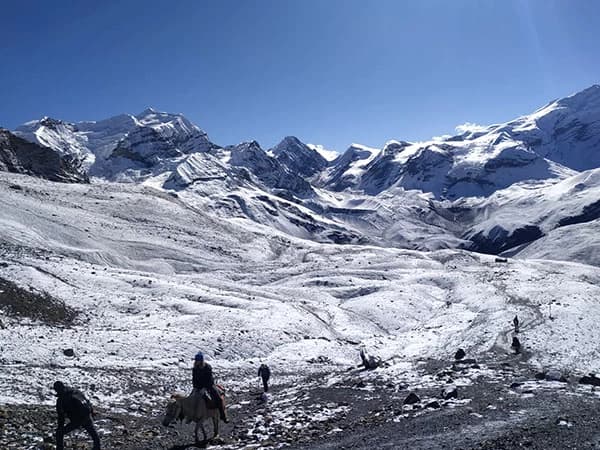
Holy Gosainkund Lake around Langtang Himal trekking offers you ever-present views of the Central Himalaya range of mountains. That includes Ganesh Himal and Manaslu towards the west and as far views to Annapurna peaks with Langtang Himal in the north direction. Panorama extends to the Jugal Himal Mountains, which includes Dorji Lakpa with a series of peaks as far as towards the Tibetan side of the mountains beyond Langtang Himalaya.
Places and Culture of Interest
The high hills people of Langtang Himal populated by Tamang indigenous tribes migrated from Mongolia and Tibet for thousands of years, even before Kathmandu Valley was still a huge lake before it was drained.
As the walk leads past Gosainkund close to the Helambu area where you will find a mix of tribes of hill people with Tamang-Sherpa and Hyalmo with similar cultures and traditional life interwoven with Buddhism religion with strong influence to Tibetan custom and heritage, as well as practice ancient Bon (pre-Buddhism sect) worshipping nature and mountain spirits. Interesting to witness its traditional farm life and culture on walks, where you can explore its lovely villages within the peaceful harmony of pristine natural surroundings.
Altitude Profile by Day
|
Day |
Location |
Altitude (m) |
Altitude Gain/Loss |
|
1 |
Kathmandu |
1,350 |
Arrival |
|
2 |
Syabrubesi |
1,470 |
+120 |
|
3 |
Lama Hotel |
2,470 |
+1,000 |
|
4 |
Langtang Village |
3,430 |
+960 |
|
5 |
Kyanjin Gompa |
3,870 |
+440 |
|
6 |
Kyanjin Ri (day hike) |
4,773 |
+903 / return |
|
7 |
Lama Hotel |
2,470 |
–1,400 |
|
8 |
Thulo Syabru |
2,230 |
–240 |
|
9 |
Sing Gompa |
3,250 |
+1,020 |
|
10 |
Gosaikunda Lake |
4,380 |
+1,130 |
|
11 |
Gosaikunda Lake |
4,380 |
Acclimatization |
|
12 |
Ghopte (via Lauribina Pass 4,610 m) |
3,430 |
+230 / –950 |
|
13 |
Melamchi Gaon |
2,530 |
–900 |
|
14 |
Sundarijal / Kathmandu |
1,350 |
–1,180 |
|
15 |
Kathmandu / Departure |
1,350 |
— |
Who Is This Trek Perfect For?
Travelers from the US, UK, Canada, Australia, Germany, Switzerland, France, Netherlands, Sweden, Norway, Denmark, Singapore, and UAE who are looking for a Nepal trekking experience that differs meaningfully from the Everest Base Camp crowds and the Annapurna tourist infrastructure.
It's ideal for: fit travelers in their 30s to 60s who have some hiking experience; pairs or small groups of friends who want a shared challenge with genuine cultural immersion; solo travelers who want to be placed in a small guided group for safety and companionship; pilgrimage-minded travelers interested in the Gosaikunda lake's religious significance; and naturalist travelers interested in Langtang National Park's biodiversity.
It's not ideal for: travelers with zero hiking experience who haven't done any preparation; people with serious heart or respiratory conditions without medical clearance; anyone unwilling to accept variable accommodation and bathroom conditions; and trekkers expecting resort-level comfort.
Booking Process
How to Book Your Langtang Gosaikunda Trek
The booking process with View Nepal Treks & Expedition is designed to be straightforward for international clients:
Step 1: Contact us via the booking enquiry form or email with your preferred dates, group size, and any specific requirements.
Step 2: Receive a detailed itinerary confirmation, cost breakdown, and deposit invoice. We require a 20% deposit to hold your dates.
Step 3: Receive pre-departure information pack covering permits, gear list, fitness preparation, and travel insurance requirements.
Step 4: Arrive in Kathmandu. Our representative meets you at the airport.
Step 5: Pre-trek briefing day in Kathmandu. Permit collection, gear check, guide introduction, and detailed route discussion.
Step 6: Trek.
Step 7: Final balance payment due on the last day in Kathmandu (or pre-arranged bank transfer). Departure transfer included.
What is the Langtang Gosaikunda Trek? A 15-day guided trekking itinerary in Nepal's Langtang region that combines the Langtang Valley, the sacred Gosaikunda Lake at 4,380 m, the Lauribina Pass crossing at 4,610 m, and the descent through Helambu Valley to Kathmandu. The route offers mountain scenery, Tamang Buddhist cultural immersion, Hindu religious sites, and one of Nepal's finest high-altitude lake experiences.
How much does it cost? Full guided package from $950–$1,250 per person, all-inclusive of permits, accommodation, meals, guide, and porter.
How difficult is it? Moderate to challenging. Suitable for fit adults with multi-day hiking experience and proper preparation.
What is the best time to go? October–November (autumn) and March–May (spring).
What permits are needed? Langtang National Park permit, TIMS card, and Gosaikunda Conservation Area permit — all arranged by View Nepal Treks & Expedition as part of the package.