Applying for Nepal trekking permits correctly in 2026 is more than just completing the necessary paperwork. It will provide you with proof of your right to hike on a trail, ensure that if a problem occurs, a travel insurance company will pay, and avoid the possibility of being sent back at a checkpoint after you're three days into your trek.
There are significant changes in the permit process this year.
The government has begun to strictly enforce the requirement for hiring a guide in nearly all national parks and conservation areas. They have replaced the paper and traditional TIMS card with an electronic e-TIMS card; there will now also be additional insurance requirements included with the permit applications.
In this guide, you will find all of the Nepal trekking permits you will need, including specific permit fees for the 2026 trekking season, step-by-step instructions on how to apply for a permit online or in person, as well as specific requirements by region for the Everest, Annapurna, Manaslu, Upper Mustang, Dolpo, and Langtang trekking regions.
Whether you are preparing for an upcoming trek or trying to manage the changes to regulations in place for 2026, everything you need is contained here.
What Is a Nepal Trekking Permit and Why Every Trekker Needs One
The Trekking permit is the official authorization provided by the government of Nepal, permitting foreigners to trek legally in certain areas of Nepal (e.g., national parks, conservation areas, and restricted areas). In general, foreign nationals who are going to trek in Nepal will need at least one permit, although there may be multiple permits required to trek the most popular trails.
The reasons for the permit system in Nepal include three primary functions enforced by the Nepal Tourism Board (NTB) since 2026: (1) Permit fee funds the conservation and maintenance of Nepal's delicate alpine environments (i.e., trail restoration, bridge restoration, and waste disposal) at higher altitudes; (2) Establishment of trekker registration, allowing emergency services to locate you; and (3) Establishment of safety standards that mandate local guides and insurance for all treks in high-risk areas.
If you are caught trekking without your permit at any checkpoint in Nepal, you will receive an on-site fine of $120. Additionally, if you are trekking in a restricted area, you may be removed immediately from the trail, your permits revoked, and deportation issued. Also, if you are caught trekking without the proper documentation, your travel insurance will likely not cover any costs associated with your helicopter evacuation.
The 5 Types of Nepal Trekking Permits Explained That Applies to Trekking Regions
Trekking Regions of Nepal
Nepal does not have a unified trekking permit system; therefore, the permit required to trek any of Nepal's trekking regions is dependent upon that chosen region and the type of national park, conservation area, or restricted zone the chosen route passes through. As of 2026, there are a total of 5 active types of permits to trek in Nepal.
1. E-TIMS Card (Trekkers Information Management System)
The e-TIMS permit is one of the most common trekking permits required for open trekking routes outside of the Everest Khumbu region. The e-TIMS Trekking Permit is issued by the Nepal Tourism Board and the Trekking Agencies Association of Nepal.
As of April 2023, individual trekkers will no longer be able to obtain an e-TIMS permit directly; all individual trekkers will be required to go through a registered trekking agency to obtain an e-TIMS permit. Therefore, the e-TIMS permit for 2026 will have QR codes that can be scanned at checkpoints, allowing for the real-time location tracking of each individual trekker.
Foreign National Fee: NPR 2,000
SAARC National Fee: NPR 1,000
Permit Required For (Annapurna, Langtang, Manaslu (most open trekking routes), etc.)
Permit Not Required For (Everest Khumbu Region (Municipality Permit, replacing e-TIMS permit)
2. National Park Entry Permit
To visit any of Nepal's National Parks, a National Park entry permit is needed. The National Park entry permit is issued by the Department of National Parks and Wildlife Conservation. The two most popular trekking national parks in Nepal are Sagarmatha National Park (Everest area) and Langtang National Park. Each of these parks has its own entrance fees and checkpoints.
Sagarmatha National Park: NPR 3,000 + 13% VAT (~28 US Dollars) for Foreigners.
Langtang National Park: NPR 3,000 for Foreigners.
National Park entry permits can be obtained at the Nepal Tourism Board office in Kathmandu and at the entry gates of the national parks.
The cost of the ACAP is NPR 3,000 for foreign permissions; they can be applied for online at the NTNC portal or directly at the NTNC office in Kathmandu.
4. Khumbu Pasang Lhamu Municipality Permit
The Solukhumbu area has a new Permit, separate from the TIMS Card (since 2018), that allows you to travel to areas in the Everest region including the famous treks like Everest Base Camp Trek 12 Days and Everest Base Camp Trek 14 Days Along with acquiring the Sagarmatha National Park Entry Permit for access to Sagarmatha National Park, you will be able to acquire the Municipality Permit, which is to be purchased in order to travel to the Khumbu area.
The cost of this permit has changed as of September 2024 from NPR 2,000 to NPR 3,000 and will stay at that rate through 2026.
5. Restricted Area Permit (RAP)
You will need a special Restricted Area Permit to trek in areas deemed sensitive by the government and those deemed protected wilderness, including Upper Mustang,Upper Dolpo, Lower Dolpo, Nar Phu Valley and Tsum Valley.
To get a RAP, you must apply through a registered trekking agency at the Department of Immigration in Kathmandu (Kalikasthan Road), and solo trekkers are unable to obtain this type of permit. It is mandatory that you have a minimum group of two foreign trekkers and one licensed guide in order to apply for your RAP.
Nepal Trekking Permit Costs 2026 With a Fee by Trekking Region
The following table contains all the currently valid permits for trekking in Nepal and the associated fees for the trekking season of 2026. Fees will be shown in Nepalese Rupees and their approximate equivalent in United States dollars as per the current exchange rate.
Please confirm with the office from which you will obtain your permit the most up-to-date, relevant fees, as the office sometimes makes updates throughout the current season.
Permit Type
Region
Cost (Foreign National)
Issuing Authority
E-TIMS Card
Annapurna, Langtang, Manaslu (most open routes)
NPR 2,000 (~USD 15)
NTB / TAAN
National Park Entry Permit
Sagarmatha (Everest), Langtang, Shivapuri
NPR 3,000 + 13% VAT (~USD 28)
DNPWC
Conservation Area Permit (ACAP)
Annapurna region
NPR 3,000 (~USD 23)
NTNC
Khumbu Municipality Permit
Everest / Khumbu region (replaces TIMS here)
NPR 3,000 first 4 weeks (~USD 23)
Khumbu Pasang Lhamu RM
Restricted Area Permit (RAP)
Upper Mustang, Dolpo, Nar Phu, Tsum Valley
USD 100/week (Upper Mustang, Dolpo Upper)
Dept. of Immigration, Kathmandu
Manaslu Circuit Special Permit
Manaslu region
USD 100/week (Sept-Nov), USD 75 (other seasons) + NPR 10 levy at Jagat
Dept. of Immigration
Important 2026 addition: New environmental Green Fee is being added to conservation area permit fees as an electronic fee (new) and not listed as a separate fee (old). In addition, you must now provide proof of travel insurance to show that you are covered for helicopter evacuation above a height of 4,000m, and this will be verified at the time of obtaining your permit and at any main control points prior to issuing your permit.
How to Get a Trekking Permit in Nepal With a Proven Steps
You will need knowledge of what type of permits you require for the specific trek you wish to make in Nepal in order to get your trekking permit, with there being slight differences in the process for open-area permits as opposed to restricted-area permits. The following will outline the steps to follow if applying for an open-area permit:
Make sure you know all of the permits that you need for the specific trek that you want to make. Most treks will require at least two permits that will be issued together. For example, you will require a Sagarmatha National Park Permit along with the Khumbu Municipality permit to hike to the Everest Base Camp; while to hike to the Annapurna Base Camp, you will need an ACAP permit along with an e-TIMS permit to do so.
You must book with a licensed trekking company. In April 2023, most routes are required to have a licensed company. Your licensing company will take care of all e-TIMS processing and will help you submit national park and conservation area permit applications.
Prepare your application documents. Your documents must include your valid passport, two recent passport-size (35mm by 45mm with a white background), proof of travel insurance including helicopter evacuation, and a copy of your trek itinerary.
You may apply for your national park and conservation area permit either online or in person. In-person applications can be made at either the Nepal Tourism Board office in Thamel (Pradarshani Marg) or at respective issuing offices in Pokhara; however, you must go to Thamel in order to make an online application through the NTNC online portal.
Most permits are QR-coded and are now scanned by checkpoints digitally. Ensure you bring a digital copy as well as a printed copy with you on your trek.
Always have and carry your trekking permits with you anywhere you go. All of the major trekking routes have checkpoints set up to check for documentation. The most strict checkpoint, with the potential of turning a group away, is Manaslu/Jagat with regard to having proper guiding documentation that matches up with the permit records used to support trekking in this area.
Processing time: Standard permits can be processed and issued within 1 day, and Restricted Area Permits will require 5-7 days (based on business days) before your trekking start date.
Do You Need a Guide for Trekking in Nepal in 2026?
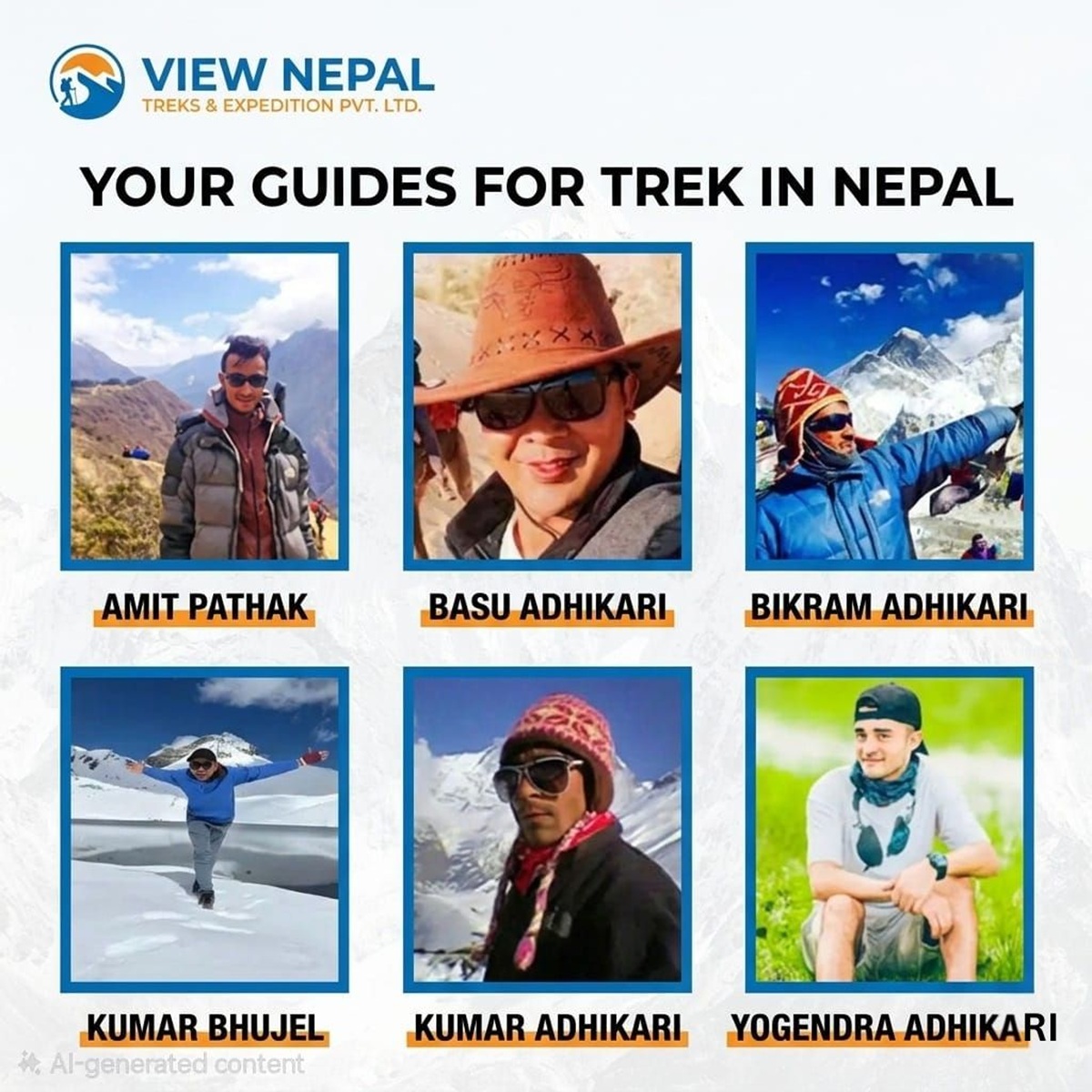
licenced and Trusted Trekking Guides of View Nepal Treks
As of 2026, foreign nationals must hire a licensed guide through a registered trekking agency to trek to nearly all areas of Nepal's national parks and to every restricted area. This policy was introduced by the Nepal Tourism Board and TAAN following a significant increase in missing person cases and deaths due to preventable accidents amongst solo trekkers in isolated areas.
Routes requiring a licensed guide: All trekking routes in Sagarmatha National Park, Annapurna Conservation Area, Langtang National Park, all treks on the Manaslu Circuit and all restricted areas are included.
Routes where solo trekking may still be possible: There will still be a limited number of low-elevation day hiking trails and trekking routes located outside of designated national parks and conservation areas where you may be able to solo trek in 2026.
To legally process your e-TIMS system, your guide must be licensed by the Nepal Tourism Board and in good standing with the registration number of their registered trekking agency. Informally purchased guides on the streets of Lukla, Pokhara and Kathmandu cannot legally process your e-TIMS in the current 2026 digital system due to your e-TIMS being directly linked to your guide's registered agency.
Guide cost benchmark: Trekking guides licensed to guide will charge between USD 25 and USD 50 per day, depending on where you are trekking and what time of year you are trekking, which is not included in your permit fee.
What are Nepal Trekking Permit Photo Requirements Related to Size, Format, and Specifications
Photo requirements are one of the most overlooked parts of applying for permits. Many trekkers arrive with the wrong format of photographs, so this causes bottlenecks and delays at the permit office, particularly during the busy season. The following specifications apply to all standard trekking permit applications for the year 2026.
Requirement
Specification
Notes
Size (printed)
35mm x 45mm
Standard passport photo size
Background
Plain white
No shadows, no patterns
Face coverage
70-80% of frame
Full face, front-facing
Expression
Neutral, mouth closed
No smiling with teeth
Recency
Taken within 6 months
Recent appearance required
Copies required
2 per permit application
Bring 4-6 total for multi-permit treks
Digital format
JPEG, min 600 x 800px
For online applications only
Local tip: Photo shops on Tridevi Marg and directly opposite the Nepal Tourism Board office on Pradarshani Marg in Thamel, Kathmandu, can get you a permit-compliant photo in under five minutes for about NPR 100 - NPR 150. If you have a multi-permit trek, bring at least half a dozen of your prints so that you don't have to make the photo trip on multiple occasions.
How to Get an ACAP Permit (Annapurna Conservation Area Permit) as a Trekker
Every trekker needs an Annapurna Conservation Area Permit (ACAP) for every Annapurna Region trekking route in Nepal's Annapurna Conservation Area (ACA). The ACA is the largest protected wildlife area in Nepal and covers over 7,600 square kilometres.
Trek routes where ACAP is required include the Annapurna Circuit, Annapurna Base Camp, Poon Hill, Mardi Himal Trek, Tilicho Lake, Khopra Danda, plus all other routes within the ACA boundaries.
The ACAP costs NPR 3,000 for foreign nationals and NPR 1,000 for SAARC nationals. It's issued by the National Trust for Nature Conservation and is valid for the whole period of your trek with no daily limit restrictions. Here's how to apply.
Online: Visit ntnc.org.np. But during peak trek season, the site may experience very high traffic and, at times, go down. If that happens, use the in-person option below.
In-person in Kathmandu: Visit the NTNC Biodiversity Conservation Centre in Jawalakhel, Lalitpur. Bring your passport, two passport-sized photos, plus your trekking itinerary.
In Pokhara: Visit the Tourist Service Centre in Damside. This is the best option for those heading out of Pokhara to start their trek.
Through a trekking agency: If you're booking through an agency, they'll take care of the ACAP permit as part of your trek fee.
Important 2026 note: In addition to the ACAP permit, you'll also need an eTIMS Card for most routes. Make sure you have both permits when you pass through checkpoints at Besisahar,
Trekking Permits for the Everest Region 2026 (World's Tallest Mountain Area): Sagarmatha and Khumbu
Everest Region in the View That requires trekking permits like
Sagarmatha National Park permit and Khumbu Pasang Lhamu rural municipality permit for entry
Unlike other trekking areas of Nepal, the Everest region has its own independent permit system. The Solukhumbu Region has discontinued the TIMS card in favour of a separate local municipality permit that ensures all revenue stays within the Khumbu region. So when trekking to Everest Base Camp, you'll need a combination of two different permits.
Khumbu Pasang Lhamu Rural Municipality Permit: NPR 3,000 for the first four weeks. An additional payment is required if you stay beyond this period. Available in Kathmandu or at Monjo Gate.
Sagarmatha National Park Entry Permit: NPR 3,000 plus 13% VAT. Obtainable from either the Nepal Tourism Board office in Kathmandu or the Monjo Checkpoint.
At Monjo Checkpoint, officers verify both permits using a QR code scanner, which also verifies the agency your guide registered with. Solo trekkers without a guide may be held up at this checkpoint and directed to either join a guided group or return to Lukla.
One helpful local tip: get both Everest region permits in Kathmandu before flying to Lukla. During peak trekking season from October to the end of November, there's usually a two to three-hour wait at Monjo for permit processing. This delay will affect your scheduled trek for the rest of the day.
Where to Get Most of Nepal Trekking Permits in Kathmandu and Pokhara
The majority of trekkers gather their permits in Kathmandu before reaching their starting point. This helps avoid delays at park gates and checkpoints during peak trekking season.
Kathmandu Permit Offices
Nepal Tourism Board, located at Pradarshani Marg, Thamel. Open Sunday to Friday, 9am to 5pm. Issues standard TIMS and other national park permits. This should be your first stop.
NTNC Office (ACAP), located at the Biodiversity Conservation Centre, Jawalakhel, Lalitpur. Open Sunday to Friday, 9am to 5pm.
Department of Immigration (Restricted Area Permits), located on Kalikasthan Road, Dillibazar, Kathmandu. Open Sunday to Friday, 9:30am to 4:30pm. Apply here for special permits for Upper Mustang, Dolpo, Nar Phu, and Manaslu.
Pokhara Permit Options
Damside Tourist Services Centre: Provides ACAP permits and can also process standard park permits. Conveniently located if you're starting your trek in Pokhara.
Park Gates: For Sagarmatha National Park permits, visit the Monjo Park Entrance. For Langtang National Park permits, visit the Dhunche Park Entrance. During peak season, there'll usually be extremely long lines, so we highly recommend purchasing your permit in advance from Kathmandu.
Restricted Area Trekking Permits in Nepal: Upper Mustang, Dolpo, Nar Phu, and Manaslu
Restricted Area Trekking Permits allow access to some of the most isolated high altitude treks and richly preserved cultures in Nepal. These regions border Tibet and contain many indigenous communities, old monasteries, and high-altitude ecosystems that the government of Nepal has restricted access to.
The only way to get these permits is through an approved trekking agency, which will submit the application to the Department of Immigration office on Kalikasthan Road in Kathmandu.
Area
Min. Group
Permit Cost
Season
Additional Notes
Upper Mustang
2 trekkers + licensed guide
USD 100/week
Year-round
7-day minimum stay
Upper Dolpo
2 trekkers + licensed guide
USD 100/week
Year-round
Camping expedition required
Lower Dolpo
2 trekkers + licensed guide
USD 10/week
Year-round
Teahouses available
Nar Phu Valley
2 trekkers + licensed guide
USD 90/week (Oct-Nov), USD 75 other
Best: Oct-Nov
Often combined with Annapurna Circuit
Tsum Valley
2 trekkers + licensed guide
USD 35/week (Sept-Nov), USD 20 other
Best: Sept-Nov
Part of Manaslu region
A minimum of 2 certified trekkers are required to travel in restricted areas. Independent travel is not permitted. DIPA takes an estimated 5 to 7 working days to process applications. So submit your application at least 4 to 6 weeks before your anticipated departure from Kathmandu.
Documents required for RAP application: Each application must include a valid passport, passport-sized photos for each traveller, a confirmed day-to-day itinerary, a letter from the registered trekking agency on agency letterhead, plus an insurance policy covering helicopter evacuation. The agency will submit all documentation on your behalf.
How to Get a Trekking Guide License in Nepal?
This section is intended for those interested in becoming a trekking specialist, whereby trekkers are able to confirm that they have hired an appropriate guide before signing a contract.
Under NTB, there are two levels of trekking guide licences to be issued by 2026. For instance, a basic guide license includes treks up to 4,000m altitude with an NTB-approved trekking guide training course completion and passing of a government examination.
The senior guide license covers all alpine routes above 4,000m including high altitude restricted areas. It also has additional requirements, most notably extra training in first aid, high-altitude medicine, and safety protocols specific to the route.
Steps to Get a Trekking Guide License in Nepal
Take an NTB-approved trekking guide course. These run year-round throughout Kathmandu and Pokhara at TAAN-affiliated training organisations.
Complete the required number of training hours. The number of hours varies by certification level. But a basic guide will typically require between 15 and 20 days of training.
Pass the NTB government examination. Examination topics include identifying trek routes, safety procedures, government regulations concerning environmental protection and waste management, plus managing clients.
Register with the NTB and get an NTB guide card issued by the government. This card will display your licensed guide number so trekkers can cross-check your number for verification before hiring you as their guide.
Trekkers who wish to verify their guide's credentials can ask the guide to provide their NTB-issued guide card. You can also verify a guide's license by searching the NTB Guide Licenses Registry at ntb.gov.np. Don't use a guide who doesn't have this form of documentation.
Common Mistakes Trekkers Make With Nepal Permits and How to Avoid Them
Using outdated information. Permit fees in Nepal are subject to seasonal change. So always check the official issuing office or your trekking agency for current fees before arriving in Nepal.
Applying for only one permit. Trekking to Everest Base Camp requires both a Sagarmatha permit and a Khumbu municipality permit. Also, trekking to Annapurna requires both the ACAP and e-TIMS permits. If you arrive at a checkpoint with only one permit, you'll most probably not be allowed to continue your trek.
Hiring a freelance guide. Only a registered guide from a recognised trekking agency can complete the e-TIMS QR permit application. A freelancer can't. So don't risk it.
Having no printed backup of your QR code. At checkpoints, agents may not have a reliable internet connection and will be unable to scan your phone. Always carry a paper copy of your QR code permit. Your trek will be delayed until your QR code has been scanned and confirmed.
Not having travel insurance documentation ready. Since 2026, proof of travel insurance has been required before a permit is issued at the permit office. So travel with your insurance documentation in hand and have it ready when you arrive.
Losing your permit mid-trek. If you lose your permit on the trail and don't have a backup, tell your guide immediately. Your guide will have backup copies that may be acceptable to checkpoint authorities. If your guide has a valid registered permit and your documentation trail is correct, you won't face significant issues as a result of losing your permit on the trail.
Nepal Trekking Permits FAQ: Your Top Questions Answered
How to get a trekking permit in Nepal?
Book a registered trekking agency and prepare your passport, 2 passport-sized photos, plus one copy of travel insurance before applying at the Nepal Tourism Board office on Pradarshani Marg, Kathmandu, or the respective conservation area office.
Standard permits are issued on the same day. But restricted area permits require 5 to 7 working days before your trek starting date, so research that ahead of time.
Do I need a guide for trekking in Nepal?
Yes. Since 2026, all national parks and conservation areas of Nepal have had a compulsory guide policy strictly enforced by the Nepal Tourism Board. It covers almost every major trekking route, including Everest, Annapurna, Langtang, and Manaslu.
Your guide should have a government-approved NTB license and be registered with an adventure trekking agency. Travel insurance will also be void if you trek into these areas without a licensed guide, and heavy fines of NPR 12,000 apply for doing so.
How to get an ACAP permit?
The Annapurna Conservation Area Permit can be obtained online via the NTNC portal at ntnc.org.np. You can also apply in person at the NTNC office in Jawalakhel, Lalitpur, Kathmandu, or at the Tourist Service Centre at Damside in Pokhara. Non-Nepali residents pay NPR 3,000. Bring two passport-sized photos plus your passport. Many Annapurna routes also require an e-TIMS card, which you can get through a registered trekking agency.
Can I get a Nepal trekking permit online?
Online trekking permit services in Nepal are currently available for some permits only. ACAP permits are available through the NTNC online portal. Some national park permits can also be started digitally. The e-TIMS is processed digitally via registered agencies. But Restricted Area Permits are not available online and must be applied for at the Department of Immigration in Kathmandu.
Is TIMS still required in Nepal in 2026?
In 2026, the traditional paper TIMS card will be replaced by the e-TIMS digital system. You'll still need the e-TIMS for most open trekking paths in the Annapurna, Langtang, and Manaslu regions. But in the Everest Khumbu region, the Khumbu Pasang Lhamu Municipality Permit has now replaced TIMS entirely. Since April 2023, an e-TIMS can only be obtained via a registered trekking agency.
What is the fine for trekking without a permit in Nepal?
Trekking without a permit in Nepal carries an on-the-spot fine of USD 120 at any checkpoint. Fines are stiffer in restricted areas and can result in immediate removal from the trail, loss of permit plus possible bans for future visits. Your travel insurance won't cover any incidents that occurred while you were in breach of permit requirements.
Do Nepali citizens need trekking permits?
Permit fees for Nepali citizens are far lower than those for foreign nationals. The e-TIMS card, for example, costs NPR 200 for Nepali citizens compared to NPR 2,000 for foreign nationals. SAARC nationals, such as those from India, Pakistan, Bangladesh, Sri Lanka, Bhutan, and the Maldives, pay lower rates and generally pay NPR 1,000 for the majority of standard permits.
ABC group joining trekking with best price and guaranteed departure