If the Manaslu Circuit is on your itinerary, the permit system is one part of your travel preparation you absolutely cannot ignore. Unlike the Everest Base Camp and Annapurna circuits, where it is possible to get everything organized upon your arrival, Manaslu operates in a significantly different manner since it lies in a government-restricted area. Thus, obtaining the permits is an entirely different story compared to the procedures on other routes due to different costs, terms, and conditions of issuance.
This guide will explain how many permits are actually needed for successful trekking in Manaslu in 2026. These include, among others, the Restricted Area Permit (RAP), the Manaslu Conservation Area Permit (MCAP), the Annapurna Conservation Area Permit (ACAP), the optional Tsum Valley permit, and local government taxation.
The guide will also explain what has changed since March 2026 regarding the process of solo trekking, the impact on Indian nationals and other SAARC citizens, why TIMS is not applicable, and what real trekkers are discussing about the permits on the internet . By the end of the reading, one should be able to prepare a correct budget for permits for the trip without the need to refer to many without the need to refer to many different sources.
Quick Answer: What Permits Do I Need for Manaslu Circuit Trek 2026?
Permit
Required?
Approx. Cost (Foreigner)
Approx. Cost (SAARC/Indian)
Manaslu Restricted Area Permit (RAP)
Yes, mandatory
USD 75-100 for first 7 days, + USD 10-15/extra day
Same rate - RAP does not vary by nationality
Manaslu Conservation Area Permit (MCAP)
Yes, mandatory
NPR 3,000 (~USD 23-30)
NPR 1,000 (~USD 7-8)
Annapurna Conservation Area Permit (ACAP)
Yes, mandatory
NPR 3,000 (~USD 23-30)
NPR 1,000 (~USD 7-8)
Tsum Valley RAP
Only if adding Tsum Valley
USD 35-40 for first 7 days, + ~USD 7/extra day
Same rate
Local municipality fee (Chumnubri Rural Municipality)
Yes, collected on trail
~NPR 1,000-2,000 (~USD 8-15)
Same
TIMS card
Not required for the Manaslu-specific zone
-
-
You will need four permits to cover the main circuit (RAP, MCAP, ACAP, and the local trail fee). A fifth permit is necessary only if you plan to visit the Tsum Valley. All permits except for the local trail fee need to be obtained from a recognized Nepali trekking company. The majority of permits cannot be applied for independently online or collected from the trailhead.
Why the Manaslu Circuit Needs Special Permits
Most of the major trekking routes in Nepal, including the Everest Base Camp trekking trail, the Annapurna Circuit, and the Langtang route, only require the payment of a conservation fee before embarking on the trek. The Manaslu route is different. The Manaslu route in Nepal has been given restricted area status, which is a different legal classification associated with environmental and security reasons, instead of just being regarded as an area open for public access.
few of the main reasons the restricted area designation is applied specifically to the Manaslu region include:
Border proximity. This trekking route runs alongside the border between the area of Nepal and Tibet, making the immigration department responsible for the people entering the area through the designated border points.
Cultural preservation. The Nubri and Tsum valleys are known to have distinct Tibetan Buddhist heritage, and that is another reason why the permission system exists in the region to prevent crowds of tourists from overrunning the region.
Environmental protection. The area has many endangered species which need to be protected, and by having a permission system, the area is able to control tourist migration into the area.
Limited emergency infrastructure: Emergency infrastructure is limited. Places at high altitudes along the remote sections near Larkya La have very limited rescue infrastructure. To keep track of who is currently on the trail, the government utilizes the permit-and-guide system.
Manaslu Restricted Area Permit (RAP): Cost and Details
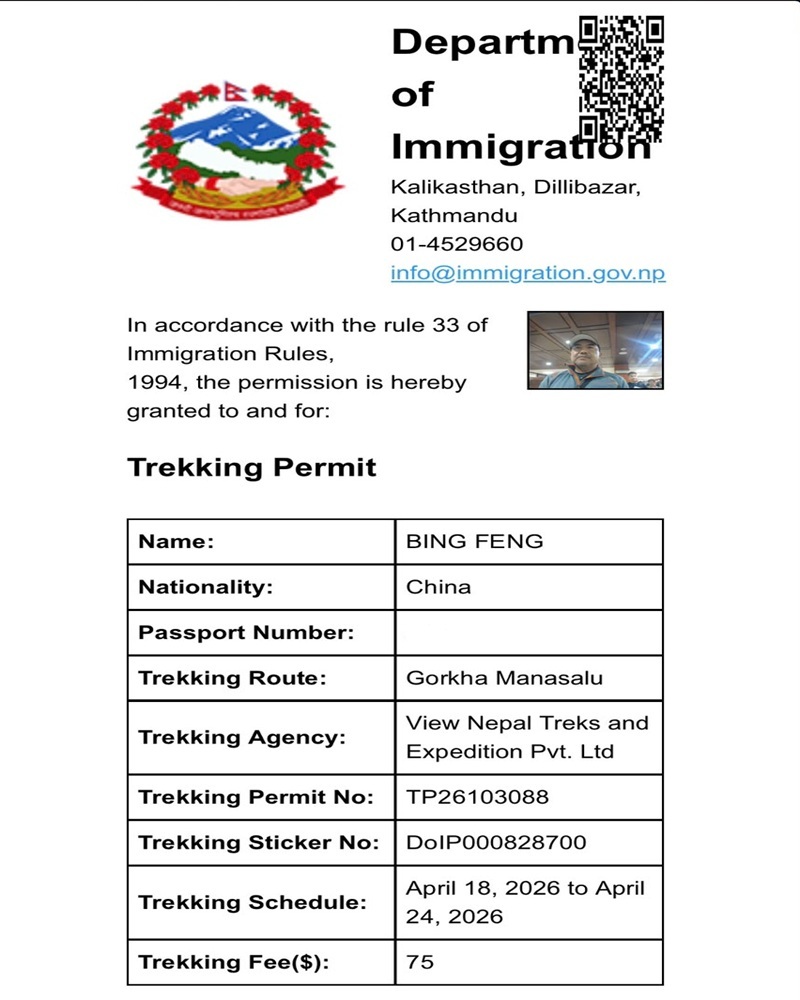
RAP obtained by View Nepal Treks
What the RAP Covers
A Restricted Area Permit (RAP) is the main pass needed to get through the Manaslu restricted area, that part of the trail which falls between Jagat and Dharapani. It is administered by the Department of Immigration in Kathmandu and will be checked at a few places along the route, with Jagat being the first real checkpoint and significant fee-based location.
RAP Cost by Season
Season
First 7 Days
Each Additional Day
Autumn (September-November)
USD 100
USD 15
Winter, Spring, Summer (December-August)
USD 75
USD 10
These prices are related purely to the number of days you will spend within the restricted area; they are not related to the length of your entire trek, so a typical 14-day Manaslu Circuit will only really have 8-10 days where the RAP fees are charged, meaning that most trekkers are unlikely to be hit with a large multi-week charge and a few extra days for the remaining time.
Does the RAP Cost Differ by Nationality?
No. Unlike MCAP and ACAP, there is no nationality distinction for the RAP. Foreigners, Indians, and SAARC nationals are all charged the same rate for their RAP, and any difference based on nationality will only be in regard to the MCAP and ACAP fee structures.
Can You Get the RAP Without an Agency?
No. You cannot obtain a RAP online; you cannot apply for it yourself in Kathmandu, nor can you simply pick one up at a government counter. It must be processed via the trekking agency you have organized through, and the agency must be government-registered. This makes the guide and agency component of most of the higher mountain treks, including Manaslu, very important.
Solo Rule Update: What Changed for RAP Applications in 2026
You may have seen mentions of a "two-person rule" when researching Manaslu recently. What you need to know right now, since this directly impacts what applies to the RAP application:
On March 22, 2026, the requirement for receiving a Manaslu RAP that stated that a minimum of 2 foreign trekkers had to apply for the permit in tandem was canceled by Nepal's Department of Immigration. Prior to this date, solo trekkers had to either take on a co-applicant or purchase a second ghost application to satisfy the stipulation of at least two applicants. From March 22, 2026 onwards, it is possible for a single applicant to request and obtain a Manaslu RAP on their individual behalf, paying the standard per-person rate in all 15 restricted trekking areas of Nepal.
The modification: the minimum number of applicants has been lowered to one person.
This did not alter: the mandatory guide requirement. This means that a trekker, whether travelling alone or in a group, must still be accompanied by a licensed guide from a registered agency for the entire duration of the restricted area. The RAP would still not be processed without the involvement of that agency.
If you are researching the solo trekking aspect in relation to the Manaslu 2026 rules - which also includes the implications on the cost of the trip and the itinerary, this will be detailed in a related article on Manaslu's solo trekking rules in the year 2026.
Manaslu Conservation Area Permit (MCAP): Cost and Details
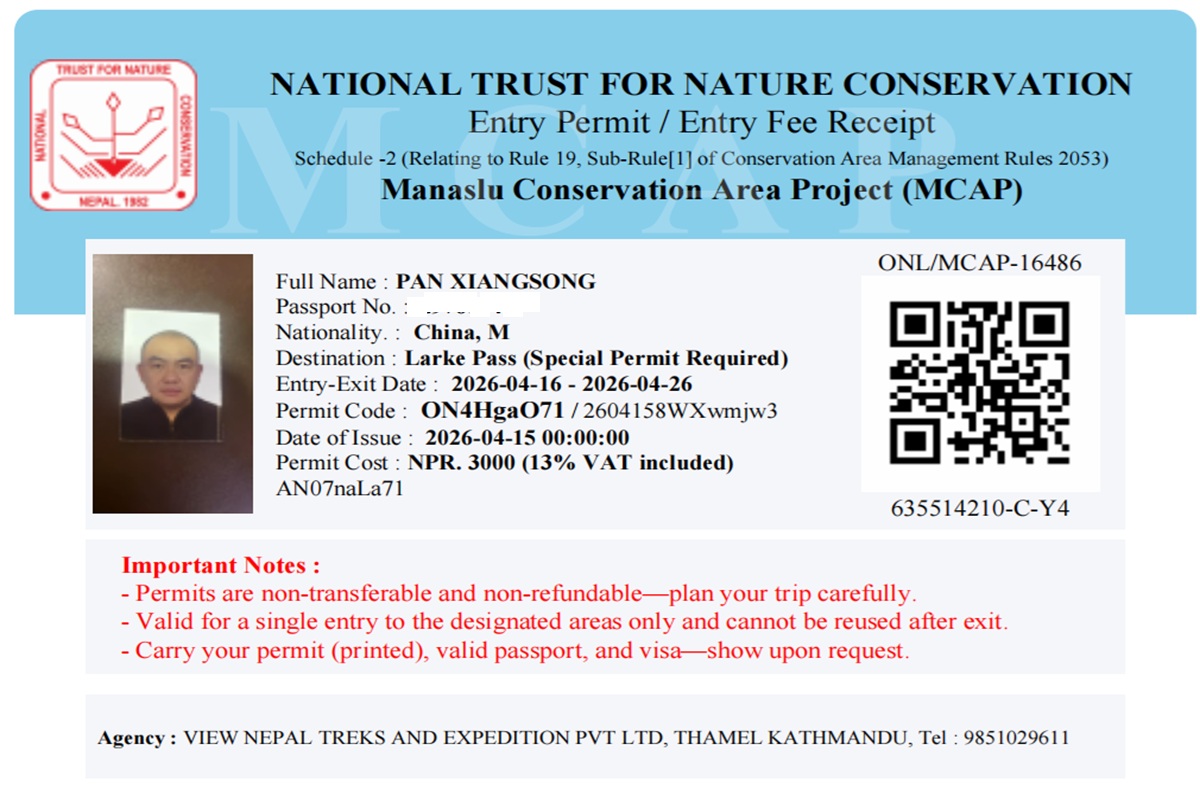
MCAP permits issued by View Nepal Trekkers
What the MCAP Covers
The MCAP covers the entrance to the conservation area, or the area designated as the protected zone around the Manaslu Massif. This is a one-time entry fee, not a daily one. It is managed by the National Trust for Nature Conservation.
MCAP Cost by Nationality
Nationality
MCAP Cost
Foreign nationals (non-SAARC)
NPR 3,000 (~USD 23-30)
SAARC nationals (including Indian citizens)
NPR 1,000 (~USD 7-8)
Nepali citizens
NPR 100
In contrast to the RAP, the cost of this permit does not vary according to the time of the year; hence, whether you hike during busy fall or calmer winter, the MCAP remains unchanged.
Annapurna Conservation Area Permit (ACAP): Why You Need It for a Manaslu Trek
Why a Manaslu Trek Requires an Annapurna Permit
The reality is that it can be quite confusing for many first-time trekkers when it comes to understanding why the Annapurna Permit is necessary to trek Manaslu. The Manaslu Circuit route also crosses the controlled area at Dharapani and passes into the mountainous region that includes the Annapurna Conservation Area (ACA) on the way to Besisahar.
ACAP Cost by Nationality
Nationality
ACAP Cost
Foreign nationals (non-SAARC)
NPR 3,000 (~USD 23-30)
SAARC nationals (including Indian citizens)
NPR 1,000 (~USD 7-8)
Similar to the MCAP, the ACAP is a fixed fee that remains constant no matter how long the trek takes or what season it is.
Manaslu Permit for Indians and Other SAARC Nationals
Trekking to Manaslu will allow Indian citizens, along with the citizens of Afghanistan, Bangladesh, Bhutan, Maldives, Pakistan, and Sri Lanka, to get the SAARC discount on two out of three permits.
Permit
Non-SAARC Foreigner Cost
Indian/SAARC Cost
RAP
Same for all nationalities
Same for all nationalities
MCAP
NPR 3,000
NPR 1,000
ACAP
NPR 3,000
NPR 1,000
If you're an Indian citizen considering the trek, here are a few important things to know:
Firstly, the RAP discount is not applicable as the Restricted Area Permit is charged at the same rate to everyone. The “SAARC discount” applies only for MCAP and ACAP, which is often misinterpreted by many trekkers, who think that the permit package is cheaper for Indian nationals.
Secondly, the independent trekking rules which came about under the March 2026 solo permit changes apply to Indian trekkers the same way as to other countries; there are no special rules for them.
Thirdly, Indian trekkers, like other nationalities, can’t bypass the requirement of using a licensed guide because of their geographical and cultural affinities to Nepal.
Finally, Indian travelers do not need to obtain a visa for entry to Nepal, though this is a separate issue from immigration and permits.
Tsum Valley Permit: The Optional Fifth Permit
What Tsum Valley Adds to Your Trip
The Tsum Valley is a side-track off the Manaslu Circuit that leads into a secluded, culturally unique valley of its own, with its own Restricted Area Status. This is not part of the typical Manaslu Circuit permit, so if you wish to include this, an additional permit for restricted area status in the Tsum Valley (in addition to the standard four) is required.
Tsum Valley Permit Cost by Season
Season
First 7 Days
Each Additional Day
Autumn (September-November)
USD 40
USD 7
Winter, Spring, Summer (December-August)
USD 35
USD 7
Should You Add Tsum Valley to Your Itinerary?
When Tsum Valley is included in your itinerary, you can expect to spend a few extra days on the trip as well as pay an additional fee for the required permits. For those who truly want to visit Tsum and its monasteries or slower-paced villages, it is worth considering. However, if you are unsure, keep in mind that it is an optional part of the core Manaslu Circuit (RAP, MCAP, ACAP) trek. The latter can be done without visiting Tsum Valley. Hence, if you are considering adding this location to your itinerary, make sure to mention it to your agency at the very beginning of your planning.
Do You Need a TIMS Card for Manaslu?
Not at all. The area that is designated as restricted for Manaslu does not require trekkers to get a TIMS (Trekkers' Information Management System) card. In this case, the Restricted Area Permit itself is used for record-keeping as usual and thus makes Manaslu distinct from the treks that are designated as unrestricted and that do need a TIMS as a requirement.
However, it should be noted that if you are planning to go beyond Dharapani and would like to trek the famous Annapurna Circuit as well, the requirements for getting a TIMS may apply in this case as well.
Full Permit Cost Breakdown for a Standard 14-Day Trek
Here are the total costs for the basic permits needed for the Manaslu Circuit for a period of two weeks, which doesn’t include the costs of guides, accommodations, or travel.
Season
RAP (approx.)
MCAP
ACAP
Local Fee
Total (Foreigner)
Total (SAARC/Indian)
Autumn (Sept-Nov)
~USD 130-160
~USD 23-30
~USD 23-30
~USD 8-15
~USD 190-235
~USD 145-175
Off-season (Dec-Aug)
~USD 105-120
~USD 23-30
~USD 23-30
~USD 8-15
~USD 165-195
~USD 120-150
These costs given above are only for the basic permits and mandatory fees involved in trekking on the route. You need to inquire about the cost of hiring a guide to trek along the way (USD 25-35), the costs of accommodation in teahouses, the cost of meals, and hiring porters.
How to Apply for Manaslu Permits: Step-by-Step
Step 1: Choose a registered trekking agency: First of all, you have to select a registered trekking agency. It is important to note that all permits need to be obtained via registered agencies. Ensure the agency has a license to conduct the process of issuing permits by Nepalese authorities.
Step 2: Lodge necessary documents: This generally means we only require a clear digital copy of your passport (during your trek), passport photo, Nepal visa and, of course, the trek dates. However, we have found a small minority insist on details about your travel insurance, particularly regarding high-altitude rescue.
Step 3: Applying for the RAP by the agency: It is done at the Department of Immigration in Kathmandu. As of March 2026, it could be done even alone without a co-applicant.
Step 4: MCAP and ACAP get processed alongside it: Processing of ACAP and MCAP at the same time as the RAP. This is done mainly through the Nepal Tourism Board and sometimes.
Step 5: Applying for the Tsum Valley permit if necessary: This is a separate application on top of the three main ones, so mention if you plan to do it early to your agency.
Step 6: Keep the hard copies on hand while on the trek: Your passport and permits should be with you all the time, as verification of documentation is standard during the trek.
How Long Does Processing Take?
Generally, the processing of submitted documents will be done quickly, generally within a day or two if carried out by an experienced agency. The peak season (September to November) might bring about more delays, so it might be reasonable to leave about a week of margin prior to your planned start date, but this might not necessarily be required.
Common Permit Mistakes to Avoid
Some avoidably repeated mistakes noted in trekker reviews and agency guidelines:
Thinking you need TIMS, which you don't for the special Manaslu-only zone. Don't go to the trouble or expense of getting one you don't require.
Believing the RAP has a SAARC rate. It doesn't; only the MCAP/ACAP prices are dependent on country of origin.
Getting in touch with an operator who may seem dubious and unlicensed. Note that permits can only be acquired through licensed agents. If they’re not obtained properly, it can result in delays or rejection of your application or invalid documents being obtained.
Miscalculating the number of days you would spend in a restricted zone: This is because the RAP will depend on the number of days spent in the zone, and miscalculating the duration may result in overpayment or underpayment and charges on your trek.
Forgetting that the Tsum Valley permit has to be obtained separately from other permits: When the application for another permit is being made, this may be forgotten.
Not including the local municipality fee: It is lower than the fee for other permits but should still be kept in mind as it cannot be avoided.
Documents Required for Manaslu Permit Applications
Normally, your agency will ask for the same kind of documents in the same cases, whether going hiking by oneself or not.
Document
Notes
Passport scan
Clear, color copy; passport should be valid well beyond your return date
Passport-sized photos
Digital copies can be used, although a few agencies may require two copies of each.
Nepal visa copy
They are usually obtained when arriving or in advance, depending on nationality.
Confirmed trekking dates
You will be asked to provide it to get the calculation of RAP fees based on days spent in the restricted area.
Travel insurance details
Insurance is often necessary; it usually covers high-altitude evacuation rescue up to an altitude of around 6,000m.
Agency booking confirmation
Your agency gets in charge of submitting the documentation to the Department of Immigration and Nepal Tourism Board on your behalf.
The update that occurred in 2026 does not modify any requirements; it simply alters the number of names of applicants to be filed in a RAP application.
Understanding the Manaslu Conservation Area
The MCA was established to ensure the protection of the region around Manaslu from potential interference as a result of tourism. MCA should be thought of as an independent unit. The areas that it covers are not completely similar to restricted zones but share many of their similarities.
The operation of the MCA is done with the assistance of the National Trust for Nature Conservation, and the area is home to a variety of animals such as the snow leopard, the red panda, and the Himalayan tahr. Also, the forests there serve as a transition zone from the subtropical lowlands of Soti Khola to the alpine territory closer to the Larkya La pass.
Wildlife conservation and habitat protection within the various altitude bands of the conservation area.
Trail and infrastructure maintenance, including bridges and facilities at checkpoints throughout the trekking route.
Local community development projects in the villages in the conservation area, especially the Nubri valley.
Since the MCA overlaps with the RAP-controlled restricted area but is not the same thing legally, trekkers must purchase both types of permit independently: the RAP for restricted area access and border monitoring by security personnel, and the MCAP for admission to the conservation area and funding the conservation effort. This explains why an entire Manaslu Circuit trek requires a greater quantity of permits compared to an unrestricted conservation-area trek in another part of Nepal, where the only required fee is the conservation charge.
As the RAP charges on a day-by-day basis for entry into the restricted zone, the cost of permits will vary considerably depending on the length of your trip. In the following table, you can find the approximate costs for a few common trip lengths using fall pricing for a foreigner not from a SAARC nation.
Restricted-Zone Days
RAP Cost (Autumn)
RAP Cost (Off-Season)
7 days (minimum)
~USD 100
~USD 75
9 days
~USD 130
~USD 95
10 days
~USD 145
~USD 105
12 days
~USD 175
~USD 125
Note that the flat fees of MCAP and ACAP will need to be added to the cost of the RAP for your trip, totaling approximately USD 46-60 for foreigners, or USD 14-16 for Indian/SARRC nationals. The local authority fee is around 8-15 USD. The cost of the RAP will need to be added according to the number of days spent in the restricted zone, but most standard itineraries are 14-day Manaslu Circuit trips that are 8-11 restricted zone days in length, as several days before entering or after exiting the restricted zone will not count.
How Manaslu's Permits Compare to Other Restricted Areas
Manaslu is not the only trekking area that has restrictions in Nepal, but comparing it to other areas gives clarity to its costs and regulations.
Region
Restricted Area Permit Required?
Approx. RAP Cost (per week)
Guide Mandatory?
Manaslu Circuit
Yes
USD 75-100
Yes
Upper Mustang
Yes
USD 500 (10-day minimum)
Yes
Tsum Valley
Yes (separate from Manaslu RAP)
USD 35-40
Yes
Everest Base Camp
No (conservation permit only)
N/A - Sagarmatha National Park fee instead
Yes (since 2023 policy)
Annapurna Circuit
No (conservation permit only)
N/A - ACAP fee instead
Yes (since 2023 policy)
Manaslu falls in the middle among the areas of Nepal with restricted access - with much lower prices than Upper Mustang, but it requires the same types of permits that are not needed in the unrestricted areas. However, the similar requirement since 2023 is a guide that is needed irrespective of the status of the tripasan event.
Pre-Trek Permit Checklist
Some important parameters which you want to check before you embark on your journey should include the following:
Verify that your representative is a registered agency and has experience in applying for restricted area permits, as not all licensed operators apply for the needed documents.
Provide your passport, photographs, visa copy and dates of travel along with ample buffer time, as travelling coincides with peak season.
Confirm with your itinerary the number of days inside the restricted area, as it is the number of days spent in the restricted area which defines the costs of your RAPs.
Make sure that you decide on Tsum Valley before putting in the application, as a separate application is needed for this trek.
Make sure you ask for the stated breakdown of the permit price.
Carry the original document with you on your trek.
Also, budget your local municipality fee in a separate account as it is paid on the trail and is not included in the pre-trek permits package.
Clearing this short list with your representative will enable you to avoid many possible pitfalls concerning permits.
Frequently Asked Questions
What permits do I need for the Manaslu Circuit Trek in 2026?
You will require three main permits-the Manaslu Restricted Area Permit (RAP), the Manaslu Conservation Area Permit (MCAP) and the Annapurna Conservation Area Permit (ACAP), plus the local municipality fee on the trail. A Tsum Valley permit will only be required if that side-trip has been added on.
How much does the Manaslu Restricted Area Permit cost?
The price for the RAP is $100 for the first seven days and then $15 for every subsequent day (Autumn: September-November), or $75 for the first seven days and $10 for every subsequent day (Winter, Spring & Summer: December-August). These prices apply to all nationalities.
How much does the MCAP permit cost?
The MCAP permits will cost non-SAARC foreign nationals NPR 3,000 (approximately USD 23-30) and SAARC nationals (including Indians) NPR 1,000 (approximately USD 7-8). The prices are flat and do not vary depending on the season.
Do I need an ACAP permit for a Manaslu trek?
Yes, you do need an ACAP since the standard route terminates in the Annapurna Conservation Area. These will cost the same as the MCAP: non-SAARC foreign nationals and Indian nationals $30 for MCAP and ACAP, respectively, and SAARC $10 for ACAP.
What is the Manaslu permit cost for Indian trekkers?
Indian trekkers must pay the same RAP price as for other foreign nationalities, but may obtain their MCAP and ACAP permits at the SAARC rate of NPR 1,000 each. The requirement for a guide still exists, however- but this is an inherent trekking rule and does not differ greatly in cost between other nationalities, unlike the visas, which add an extra amount to the total cost of the trek (this is not applicable to Indian citizens).
Do you need a TIMS card for the Manaslu Circuit Trek?
No, the RAP serves as a replacement for the TIMS Card on the Manaslu Circuit trek. If you are continuing beyond the standard exit point for the Manaslu onto the classical Annapurna Circuit, then you may still need to apply for this, depending on the itinerary.
Is a Tsum Valley permit included in the standard Manaslu Circuit permits?
The Tsum Valley permits are extra and not included in the regular Manaslu permits. If you plan on hiking through the valley itself, then it is worth applying for an additional permit-the Tsum Valley Restricted Area Permit is approximately USD 35-40 for the first week, depending on season; however, the more you stay, the less the price will be.
Can I get Manaslu permits myself without an agency?
No, this permit needs to be arranged through a registered Nepali trekking agent. There is no way to apply online directly or to collect this by yourselves at the appropriate administrative body.
How much do all the Manaslu permits cost together?
For a standard fourteen-day Manaslu Circuit trek, the total fee cost will amount to somewhere around USD 190-235 for non-SAARC foreign nationals (Autumn: September-November) and somewhere around USD 145-175 (SAARC & Indian nationals), again taking into account that permit fees may be lowered outside of the high season.
What happens if my trek runs longer than planned inside the restricted zone?
You will have to pay the aforementioned prices for every extra day inside the Manaslu Restricted Area ($15 for autumn season, $10 for winter/spring/summer season)-usually this is arranged by the trekking agency, or handled through the guide if there are any unplanned extensions.
Are Manaslu permits refundable if I cancel my trek?
No, permits which are used in restricted areas cannot be refunded or transferred. This is to plan well on the route and then reconfirm with the trekking agency before booking the ticket.
Do children need separate Manaslu permits?
With very few exceptions, yes. Restricted Area permits usually apply to every trekker regardless of age; it is important to confirm policy on this matter with your trekking agency prior to making arrangements if you are traveling with children.
Where can I verify current permit rates before booking?
The regulations regarding permits are governed by the Government of Nepal's Department of Immigration and Nepal Tourism Board. You should always re-confirm these official permit fees with the trekking agency you select for permit purchases before finalizing your booking, as these changes are made on a regular basis, and any price published in an article may be outdated or incorrect.
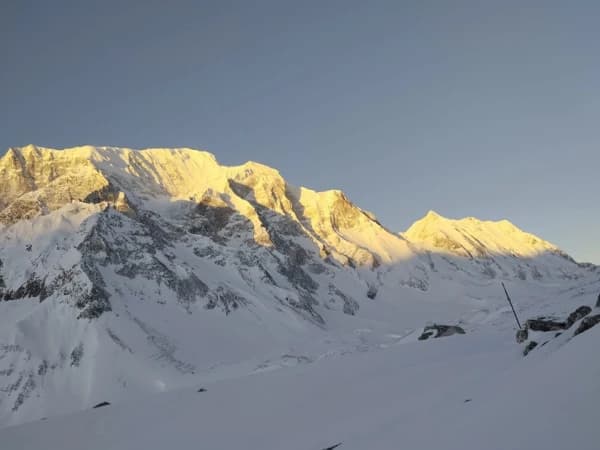
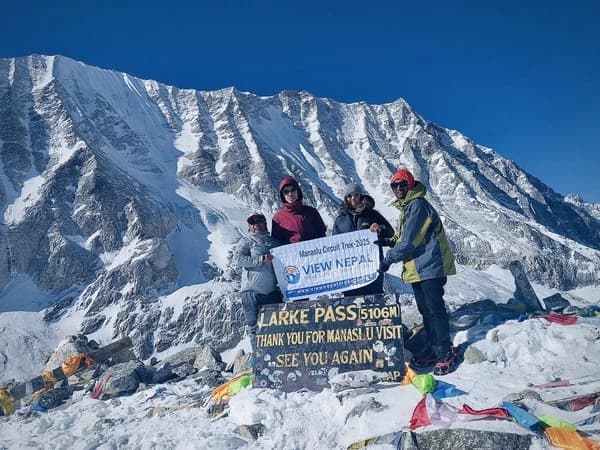
Manaslu Circuit Larkey pass Trek start from Barpak (Epicenter of Earthquake 2015), samagaun, monasteries , Tibet boarder and Larkey Pass